21st Magazine Article

HARNESSING THE UNTAPPED POTENTIAL OF KP’s YOUTH

Zeeshan Hoti

Khyber Pakhtunkhwa (KP) has always been a land of cultural richness and variety. For centuries, it stood against the furore of empires and ideas. The Silk Road wound its way through the solid rocks of its mountains, carrying merchants, scholars and mystics between Central Asia and the subcontinent, thus establishing a solid bedrock for its youth.

The youth of KP, about 51–53 percent of province’s total population, is an unparalleled asset, poised to drive Pakistan’s progress and prosperity.  With the right opportunities and resources, they have the potential to become a formidable force, contributing to economic growth, social development and national advancement.

Entrepreneurship Opportunities

KP government has taken significant strides in promoting youth entrepreneurship, recognizing its potential to create jobs, stimulate innovation and drive economic growth. The launch of the Rs 1 billion Youth Entrepreneurship Programme is a commendable initiative, providing financial support and skill development guidance to young entrepreneurs. This program has the potential to unveil a new wave of innovation providing and enabling young minds to turn their ideas into successful businesses.

The Jawan Marakiz, a youth-focused initiative, provides a platform for young people to access resources, training and networking opportunities that enhances their expertise in the fields of innovation and entrepreneurship. These initiatives speak of the government’s commitment to empowering youth and providing them with the necessary tools to succeed.

Skill-Based Migration and Remittances

Many young individuals from KP are seeking skill-based opportunities abroad and their skills if utilized, can be a valuable asset and bring about a tremendous socio-economic development at home. The Remittances sent by these migrant workers play a significant role in Pakistan’s economy, with over $656 billion sent globally in 2023. The KP government can facilitate skill-based migration by providing training and certification programs, making it feasible for young people to access international job markets.

Skill-based migration can have a transformative impact on KP’s youth, enabling them to acquire new skills, gain expertise in their respective fields via international experience and contribute to Pakistan’s social and economic growth. The government can leverage this opportunity by providing vocational training, language courses and job placement services, ensuring that young people are equipped to compete in the global job market.

Social media: A boon or bane

Social media has become an integral part of young people’s lives, offering numerous benefits, including connectivity, education and self-expression. However, it also poses risks, such as propaganda, cyberbullying and online harassment.

Harnessing Social Media for Positive Change

To harness the benefits of social media, youth need to develop critical thinking and digital literacy skills. This includes verifying information, practicing digital citizenship and ensuring online safety.

Social media can be a powerful tool for promoting social and political awareness, enabling young people to raise consciousness regarding social issues, mobilize support and create positive change. By harnessing social media’s potential, KP’s youth can become agents of change, promoting tolerance, understanding and social cohesion.

Social Media Literacy: A Key to Empowerment

Social media literacy is of utmost importance for young people to navigate the digital landscape effectively. This includes:

  • Verifying Information: Checking sources and fact-checking before sharing content.
  • Digital Citizenship: Being respectful and responsible online.
  • Online Safety: Protecting personal information and avoiding online threats.

By developing these skills, young people can explore onto social media’s potential, promoting positive change and avoiding its pitfalls. Also, government of KP has launched multiple platforms under the surveillance of federal government agencies to ensure to debar the spread of propagandas and anti-state elements.

Avoiding Propaganda: Promoting Critical Thinking

Young people can avoid propaganda by staying informed, accessing credible news sources and fact-checking information. Critical thinking is essential in analyzing information objectively, questioning sources and reporting suspicious content.

The KP government can play a significant role in promoting media literacy, providing young people with the necessary skills to navigate the digital landscape effectively. By empowering young people with critical thinking and digital literacy skills through academic curriculum or short courses, we can promote a culture of tolerance, understanding and social cohesion.

Conclusion

The youth of KP are a valuable asset, having the potential to drive Pakistan’s progress and prosperity. By promoting entrepreneurship opportunities, skill-based migration and social media, we can unlock their potential, promoting economic growth, social development and national advancement.

The KP government has taken significant strides in promoting youth empowerment and it is essential to build on this momentum. By providing young people with the necessary resources, training and support, we can create a brighter future for Pakistan, one that is driven by innovation, entrepreneurship and social change.
VoKP 21st Magazine Artile

KP ECONOMIC POTENTIAL BETWEEN WHAT EXISTS AND WHAT IS DONE (2025)

Dr. Bashir Ahmad

Khyber Pakhtunkhwa (KP) has spent years being marketed as a province of promise. In policy speeches, budget documents and development forums, it is repeatedly described as “resource-rich,” “strategically located”, and “demographically young.” By 2025, this vocabulary feels exhausted. Potential, after all, is meaningful only when it moves toward performance.

KP today is not short of assets. But persistently what it lacks is the ability to organise those assets into a coherent, growth-generating economic strategy. The province stands at a moment where repeating the language of opportunity is no longer enough; outcomes must finally justify the optimism. Potential is what policymakers invoke when outcomes fail to materialise. The uncomfortable truth is this: KP is not short of resources, people, or strategic relevance. It is short of execution.

2025 Overview: Stability Without Transformation

Economically, KP enters 2025 in a position of relative stability but limited momentum. The province contributes around 10–11 percent to Pakistan’s GDP, a modest share given its population size and labour force, as it accounts for nearly 18 percent of the national population, underscoring an output gap relative to its demographic size. Agriculture, services, remittances and public-sector activity remain the backbone of the economy, while industrial activity remains thin and regionally concentrated. KP’s labour force exceeds 11 million people, nearly 16 percent of Pakistan’s total workforce.

On paper, these are respectable numbers. On the ground, they translate into widespread un-Der employment, a swollen informal sector and a generation of young people waiting for an economy that never quite arrives. Labour force participation, particularly among women, remains significantly below national averages. Youth unemployment and underemployment are widespread, masked only by informality and outward migration. Labour force participation, particularly among women, remains significantly below national averages. Nationwide, female participation stands at about 24.4 percent, compared with male participation of nearly 69.8 percent, underlining deep gender gaps that are even more pronounced in KP.

Fiscal indicators often paint a flattering picture. KP has periodically posted budget surpluses, evident from the recorded surplus of over Rs56 billion in the 2024-25 fiscal year, according to the Economic Survey of Pakistan 2024-25, earning praise for “sound financial management. But these surpluses are frequently the result of development under-spending, not economic expansion. Roads not built, industries not established and skills not developed do not show up in balance sheets, but they define lived poverty. Fiscal discipline achieved by delaying building schools and hospitals may balance books, but it also freezes growth.

In short, KP’s economy is holding but it is not moving.

Potential of the Province: Geography Is Not Destiny

KP’s strategic location has long been presented as its strongest economic advantage. Positioned at the crossroads of South and Central Asia, the province remains a corridor rather than a commercial hub. Trade passes through; value does not stay. Connectivity without production has created movement, not momentum, and KP remains largely a transit space, not a production centre. Improved roads and corridors have enabled movement, but movement alone does not generate prosperity. Trade passes through the province; value rarely stays.

The missing link has been commercial depth (industrial clustering, warehousing, export processing, and trade facilitation). Without these, connectivity becomes cosmetic. Geography creates opportunity, but institutions determine outcomes.

21st Magazine Article

Natural Resources: The Burden of Untapped Wealth

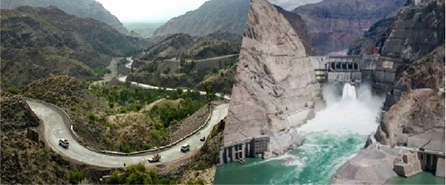
KP’s natural resource base is among the richest in Pakistan and among the least productively utilized. KP’s rivers alone represent some of the most significant untapped energy resources in the country.  The province holds an estimated 30,000 megawatts of hydropower potential, nearly half of the national total. Yet only a small fraction has been harnessed. While Pakistan’s overall hydropower exploitation remains limited (about 6,600 MW developed out of roughly 60,000 MW national potential).

KP also possesses significant reserves of natural gas (estimated at 16 trillion cubic feet), marble, limestone and other industrial minerals. Yet rivers flow unused, raw materials leave unprocessed and energy is imported at high cost. Resource abundance, without industrial policy and value addition, has delivered little beyond slogans. The entire local economies depend on mining and quarrying. Still, the dominant model remains extractive: raw materials are exported with minimal processing, while finished products are imported back at higher cost.

The dual impact of this economic loss / crisis is stark: plummeting revenue and vanishing jobs are crippling the economy. Resource abundance, without value addition and regulation, has not delivered prosperity. It has delivered dependence.

21st Magazine Article

Human Capital: Youth as an Unfinished Investment

KP is one of Pakistan’s youngest provinces. More than half its population is under 30, often described as a demographic dividend. But dividends require investment and patience. Literacy rates remain in the mid-50 percent range and education quality varies widely. According to national assessments, literacy in KP is about 51–53 percent, trailing behind provinces like Punjab. On the face of varied education quality, universities produce graduates faster than the economy produces jobs. Technical and vocational training remains underdeveloped and poorly aligned with market needs.

As a result, KP exports labour instead of retaining talent. Migration and remittances keep households afloat but hollow out local productivity. A young population without employment pathways is not an asset but a risk deferred. In other words, KP exports labour, relies on remittances, and struggles to absorb educated graduates into productive work. A demographic dividend, when ignored, turns into a social liability. Human capital is not just about education. It is about absorption. KP educates, but struggles to employ.

Digital Economy: A Narrow Window of Opportunity

Among KP’s many narratives, the digital economy stands out as a rare source of cautious optimism – a rare opening.

In 2025, significant public funds, around Rs18 billion, have been allocated for digital skills development, IT training and technology promotion. Projects such as Haripur Digital City aim to create thousands of tech jobs and integrate KP into global IT markets. Haripur Digital City, costing around Rs8 billion, aimed to create over 4,000 high-tech jobs and generate significant export earnings once operational. Training programmers are designed to reach over 27,000 youth, with scholarships for global certification opportunities. These initiatives matter. Digital services offer KP a chance to bypass some physical and industrial constraints. Freelancing, software services and remote work can connect local talent to global demand; in Pakistan overall, digital platform employment now accounts for a measurable share of the workforce (about 2.9 percent), highlighting the expanding gig and digital labour market.

But digital optimism must be grounded. Training without jobs, freelancing without safeguards and innovation without infrastructure risk becoming yet another half-fulfilled promise.  Digital growth demands speed, consistency and infrastructure, which KP’s bureaucracy fails to fairly execute.

The digital window is real but it will not remain open indefinitely.

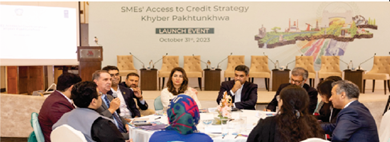
SMEs: The Economy That Carries the Province: Beyond strategies and speeches lies KP’s real economy: small and medium enterprises.

From workshops in Peshawar to agribusinesses in Swat and transport operators across the province, SMEs employ the majority of the workforce. They absorb shocks, create livelihoods and sustain local markets. At the base of the economy sit SMEs, the real employers and the real risk-takers, operating with limited credit, unreliable energy and policy uncertainty. They carry the economy quietly while policy debates orbit elsewhere.

Yet SMEs operate under constant strain, limited access to credit, unreliable energy, regulatory uncertainty and weak legal protection. Facilitation portals and policy announcements help at the margins, but structural constraints remain.

If KP seeks inclusive growth, SMEs must move from the periphery of policy to its centre. Without them, growth will remain narrow and unstable.

Point to Ponder: The End of Comfortable Narratives

By 2025, Khyber Pakhtunkhwa can no longer afford to live off the language of potential. The province does not need another vision document. It needs hard decisions value addition, employment, industrial depth and governance reform.

Natural resources without value addition, youth without employment, fiscal discipline without development and digital ambition without execution all point to the same reality: the province is managing expectations, not transforming its economy.

Potential is not a plan. And 2025 should be the year KP stops living off it.

VoKP 21st Magazine Article

PEACE EFFORTS IN KP THROUGH JIRGAS

Hassan Sajid

Across the world, every community has its own way for the resolution of conflicts. Among Pashtuns, one tradition has stood firm for centuries, “the Jirga”. For generations, the Jirga has been the heart of Pashtun society, a respected forum where elders and community members come together to solve disputes with justice, utilizing collective wisdom. Whether the issue be a family conflict, an inter-tribal clash or a major issue of regional peace, the Jirga provides a path that people trust. From resolving enmities and revenge killings to deciding issues of land disputes, water and tribal harmony, the Jirga provides a solution that help prevent violence.

Even today, in a modern and fast-changing era, the people of Khyber Pakhtunkhwa (KP) continue to give great value to this traditional system. The reason is simple, the Jirga has helped the Pashtun people maintain peace during difficult times. In many areas of KP and the newly merged districts, security challenges have increased pressure on communities. But alongside government efforts, political dialogue, and security operations, the Jirga remains a powerful tool for unity and peacebuilding.

Jirga is also a powerful way to educate youth and citizens about unity, responsibility and peaceful coexistence. Through open discussions and guidance from respectful community leaders, a jirga teaches younger generations how to address issues with wisdom instead of violence. It strengthens social values, builds understanding between tribes and communities, and reminds people that progress comes from collective decision-making.

For centuries, Pashtuns have relied on the Jirga to settle even the biggest disputes. It is considered a symbol of justice and fairness—a place where voices are heard, decisions are respected and everyone works together for the common good. This is why today, when KP faces rising security challenges, the Jirga system is once again being recognized as a crucial tool for restoring peace. It is not just a tradition; it is a social system that brings people together.

In recent months, several significant Jirgas have taken place. Some led by top national leadership, others organized by the KP government, political parties and security forces. All these efforts share one goal: restoring lasting peace in KP by engaging the people directly.

Magazine article

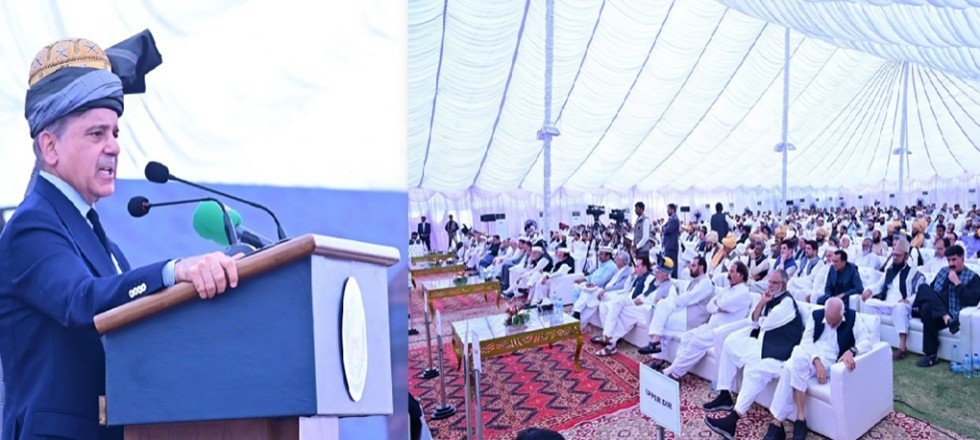
On 3 June 2025, the federal government held a Grand Jirga in Peshawar, underlining its commitment to KP’s peace and stability. In this gathering, Muhammad Shehbaz Sharif, the Prime Minister of Pakistan, addressed tribal elders and people of KP, joined by top military leadership, including Syed Asim Munir, Chief of Army Staff & Defence Forces, along with provincial leadership: the Governor of KP, the then-Chief Minister and other federal and provincial ministers.

This grand Jirga brought together residents, tribal elders, Masharaan (senior tribal figures), Representatives of various political parties, Youth groups, academia and civil society members.

The atmosphere of the Jirga reflected unity and seriousness. People spoke openly about security issues, economic challenges and the growing threat of terrorism in their areas. For many attendees, this was the first time in years that such high-level leadership had come forward to listen directly to the people.

This Jirga agreed upon the following;

The need for a united front against terrorism

  • Full cooperation between local communities and security forces
  • Strengthening border management
  • Improving development in the merged districts
  • Addressing the concerns of displaced families
  • Ensuring political parties work together for peace

The participation of the Prime Minister and Foreign Minister highlighted that peace in KP is not just a provincial issue, it is a national priority.

Recently, the Inspector General of Frontier Corps (IGFC) KP held a Youth Jirga, bringing together young people from different districts. Youth shared concerns about unemployment, lack of sports facilities and insecurity. They also asked for more educational opportunities and digital training centers.

 The purpose was simple: the youth must become partners in peace. Their fresh ideas and energy make them the strongest force against extremism.

The success of the recent peace efforts shows that the Jirga still holds great power. It works because:

  • People trust it
  • Everyone can speak openly
  • It reflects Pashtun values
  • Decisions are made collectively
  • It prevents violence
  • It binds the community together

On 17 August 2025, ANP convened an APC, inviting 19 political parties to discuss the worsening law-and-order situation, grievances of merged districts, alleged resource exploitation and security.

The parties agreed that:

  • Terrorism is a threat to everyone, not just one party.
  • Political unity is essential for long-term peace in KP.
  • The government must take firm action but also ensure human rights.
  • Local communities should always be consulted.
  • Development and education are key to fighting extremism.

The APC was widely appreciated by the public as a sincere effort, not a political show. For once, parties put aside their rivalries and stood together for the sake of the province.

On 12 November 2025, the second grand effort came when the provincial authorities of KP decided to convene a broad-based Peace Jirga in the KP Provincial Assembly.

This jirga was aimed at forging a unified strategy for restoring peace. It was to bring together sitting and former lawmakers, representatives of all political parties, tribal elders, civil society, lawyers, journalists, former governors and chief ministers, representing “all stakeholders.”

This Jirga was mainly joined by Sohail Afridi Chief Minister of KP, Babar Saleem Swati Speaker of KP Assembly and leaders of political parties (from ruling and opposition), tribal elders, members of civil society, media, lawyers’ bodies, religious scholars and youth.

The Peace Jirga adopted a 15-point declaration. Following are the main demands and recommendations from the declaration of this jirga;

Empower the provincial police and the Counter‑Terrorism Department (CTD) to lead internal security, with constitutional support.

  • Provide special financial resources to the police and CTD, given the deteriorating security situation.
  • Establish provincial “peace forums” involving civil society, youth, minorities and women, extending beyond politicians or elders alone.
  • Demand that the federal government consult KP when shaping policies related to Afghanistan — because foreign & Afghan border policy directly affects KP’s security.
  • Reopen and safeguard cross-border trade routes with Afghanistan; resume normal trade; ensure economic development.
  • Ensure that local governments in merged districts get full financial rights (linking Provincial Finance Commission with National Finance Commission), giving them autonomy and resources for development.

This jirga stands out as perhaps the broadest inclusive forum in KP’s recent history, where provincial government, parties, civil society, tribal leadership and youth were all present at the same table.

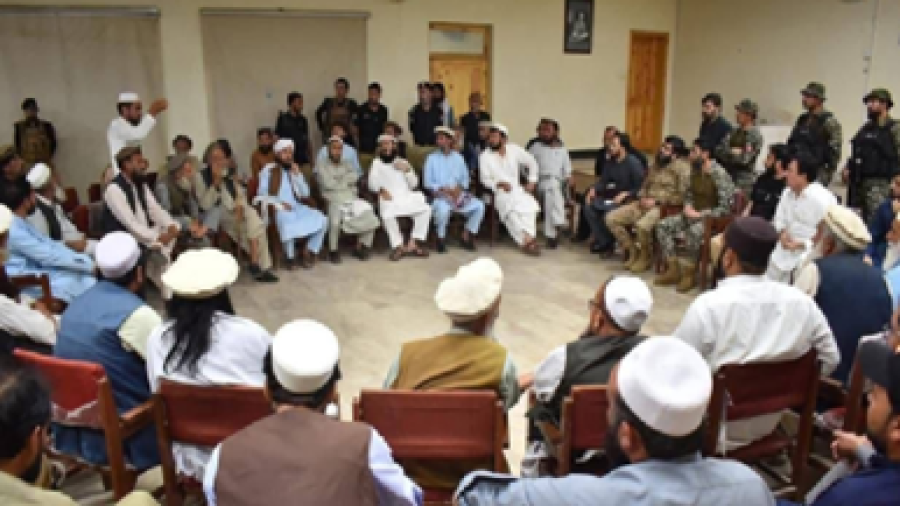
Perhaps the most impactful work is happening at the grassroots level, where local Jirgas are being held by security forces across KP and the newly merged districts. In tribal areas of KP, specifically Khyber, Bajaur, Mohmand, South and North Waziristan, Tank, D.I. Khan, and Lakki Marwat, militants often exploit the geography, tribal rivalries and lack of development. To counter this, the security forces regularly meet with tribal elders in Jirgas to build trust and strengthen cooperation. During these Jirgas, local people are told that peace is only possible when communities stand with the state. Without local support, no operation can completely eliminate terrorism.

Security forces emphasize on identifying and reporting suspicious individuals, exposing facilitators of terrorists, supporting local peace committees, keeping an eye on outsiders entering their villages, protecting schools, health centres, and public property and teaching youth to avoid extremist influence.

In a time when KP faces serious challenges, the Jirga continues to serve as a trusted, respected, and unifying force. As long as communities and leaders continue to use this system wisely, KP can move toward a safer, more peaceful future.

VoKP 21st Magazine Article

CORRUPTION IN KP AN ANATOMY OF A SYSTEMIC CRISIS

Engr. S.Khan

Corruption in Khyber Pakhtunkhwa (KP) is widespread and multi-form. Phantom or ghost projects, fake invoices and forged Cheques, procurement manipulation (over-pricing, single-sourcing, kickbacks), payroll/HR fraud, unauthorised retention of public money and diversion of development funds into private pockets or unrelated accounts remain persistent features of governance. Large audit reports and press investigations show hundreds of billions of rupees of irregularities at the provincial and local-government level in recent audit cycles, with especially large totals reflected in recent AGP coverage and the dramatic “Kohistan” scandal in KP that exposed Rs 36 billion embezzlement. These failures affect both local (provincial treasury) funds and externally funded projects (donor/World Bank/loan funds), as weak controls, politicized oversight, and collusion make both streams vulnerable. A recent trend indicates that corruption funds are now being transferred through cryptocurrencies into desired foreign beneficiary accounts.

FY Total Outlay

(Bn)

Dev (Cap)

(Bn)

Non-Dev Current

(Bn)

AGP- Flagged Irregularities


Corruption %
2020-21 923.0 318.0 605.0 37.20 11.71%
2021-22 1,118.3 371.0 747.3 52.44 14.13%
2022-23 1,332.0 418.2 913.8 52.66 12.59%
2023-24 462.0 112.385 349.6 40.76 36.27%
2024-25 1,754.0 416.3 147.0 35.34%

Ghost Projects and Development Budget Abuse

Phantom or ghost projects and fake expenditures in development budgets are particularly attractive because large sums flow through PC-I and works accounts. Auditors repeatedly find projects that either do not exist on the ground or were billed for works never done through bogus progress certificates and fake Cheques. The KP “Kohistan” scandal stands as a clear modern example where district-level accounts showed massive withdrawals for “development,” but auditors and NAB uncovered forged Cheques, dummy contractors and Benami accounts. Recovery operations later seized properties and luxury vehicles. This represents a classic ghost-project pattern in which paper projects are created and pay orders or Cheques are generated to route money through shell accounts.

Procurement Manipulation and Contract Collusion

Procurement manipulation is equally entrenched. Many audit reports document systematic mis-procurement, inflated contracts, collusion with suppliers, splitting of tenders to avoid competitive bidding and awards to connected firms. Punjab’s AGP- flagged audit findings reported exceptionally large amounts in mis-procurement and overpayments, amounting to Rs 613.9 billion in 2025, illustrating how inflated contracts steal the development premium meant for improved infrastructure.

Donor Funds and Politicized Development Planning

Foreign and donor-funded projects are not immune. While projects supported by the World Bank, ADB, Global Fund, Islamic Development Bank and EU grants carry formal safeguards, weak implementation and gaps in local oversight allow fraud through false invoices, unsupported claims and ghost beneficiaries. Local political capture further distorts development planning, with projects often sized or located for political patronage through jobs and contracts for supporters rather than genuine public need. This produces duplicate or low-impact schemes and encourages contractors to collude with officials to extract rents.

Corruption Beyond Development: Payroll, Banking and Health

Corruption also extends beyond development spending. Payroll and HR fraud, including ghost employees, illegal appointments, salary payments to Benami accounts and irregular recruitment, are repeatedly documented in provincial audit reports and place a recurring burden on public finances. Auditors  have also identified cases of unauthorized retention and off-budget banking, where provincial entities retained consolidated fund receipts in commercial bank accounts, diverting liquidity from treasury control and creating opaque slush funds. Health-sector procurement of medicines, medical equipment and recurring consumables remains a frequent corruption target through over-invoicing and fake tenders.

Collusion: How Corruption Becomes a System

Corruption in governance is often misunderstood as the wrongdoing of a single individual or department, whereas in practice, large-scale corruption thrives on collusion. Coordinated arrangements among multiple stakeholders across institutions transform corruption from isolated misconduct into an entrenched system of rent-seeking. Recent AGP and press coverage reveal massive irregularities across KP local bodies over several years, with combined audit totals reaching hundreds of billions of rupees. The Kohistan mega scandal exposed forged Cheques, dummy contractors and an organised scheme to drain district development accounts, providing a concrete, high-profile example of the ghost-project pattern. Recovery operations have seized assets and investigations continue, while anomalies across KP suggest that around 40 percent of development funds are lost to kickbacks and corruption. Less mature procurement oversight at district offices, weaker bank controls in remote branches and opportunities created by emergency and post-flood reconstruction projects have further opened space for large-scale theft.

Structural Drivers Behind the Corruption Economy

These patterns are driven by deep structural factors. Provincial and district officials exercise large discretionary power over procurement, project approvals and payments with limited real-time public transparency, allowing rent-seeking to flourish where oversight is weak. Institutional capture and politicization enable political influence over procurement committees, public accounts committees and sometimes even audit offices, protecting culprits and blocking accountability. Fragmented accounting systems and weak IT infrastructure facilitate bogus Cheques, duplicate billing and ledger manipulation, as seen in the Kohistan forged-Cheque scheme. Gaps in banking and treasury controls at local levels allow illicit withdrawals from designated accounts, while weak, slow or selective enforcement by NAB, police and provincial accounting authorities delays accountability. Even when assets are recovered, prosecutions often take years or end in plea bargains. Low civic oversight and information asymmetry further limit accountability, as citizens and local media lack access to project-level financial data, PC-Is and contract documents. Supply side capacity constraints, including low pay, weak training and staff shortages in audit and procurement units, encourage negligence or collusion, while perverse incentives in development programming prioritize politically visible but low-value projects over quality and value-for-money.

THE 2025 CORRUPTION LANDSCAPE

Kohistan Corruption Scandal

Kohistan Corruption Case is the largest corruption case in KP’s history, both in scale (Rs 36 billion) and complexity (fake cheques, shell contractors & senior officials involved), covering period from 2016 to 2024. In April 2025, NAB started a probe regarding the misappropriation of government funds in ‘KP Government Contractors Security Deposit Account’. NAB inquiry has exposed a well-planned embezzlement of more than Rs.36 Bn so far, from public accounts in Upper Kohistan (funds are not restricted to Kohistan Only). NAB has recovered Rs 22.14 billion, while an inquiry is in process for more recoveries. The case is an epic example of white-collar crime, spread across entire KP, revealing connivence of all stakeholders.

Cities Improvement Project (KPCIP) Scandal

Cities Improvement Project (KPCIP), a Rs 97 billion ($600 million) worth urban infrastructure and municipal services program, was launched in late 2022 in Peshawar, Abbottabad, Kohat, Mardan, and Mingora. It has been jointly financed by Asian Development Bank (ADB), the Asian Infrastructure Investment Bank (AIIB) and the KP government, with a targeted completion by the end of 2026. An audit report in February 2025 uncovered Rs 8.48 billion in discrepancies in the same program spread across various categories, including ghost works, inflated costs, unauthorized design changes, excessive consultancy fees, overpayments and breach of procurement norms. Misappropriations included Rs 8.8 million for non‑executed tasks, Rs 34.9 million in fake measurements, Rs 5.48 million on unstated excavation and inflated vehicle purchases, among others. Moreover, provincial assembly members petitioned the Public Accounts Committee (PAC), alleging Rs 32 billion in further irregularities. According the provided data, contracts have been awarded to unregistered firms, disbursements for minimal on-ground work, false progress reports, and tax evasion.

Government Accounts Audit & irregularities – Estimated Amount (200 billion)

Irregular procurement, overpayments in salaries and dubious contracts were documented in dozens of cases. Broad provincial audit findings in 2025 uncovered extensive issues across multiple departments:

  • Rs 982 million in alleged fake payments and fictitious expenditure.
  • Rs 14 billion in irregular budgeting and fund releases.
  • Rs 4 billion in unauthorized expenditures.
  • Rs 11.6 billion losses due to various cases.

World Bank Project Scam – Estimated Amount (106 billion)

A departmental inquiry uncovered Rs106.04 million fraud in the KP Human Capital Investment Project (World Bank-supported), involving forged cheques and fraudulent withdrawals. Investigators recommended FIRs, exit control list actions and forensic audits

Timber Scam – Estimated Amount (1.7 billion)

An illegal timber trade scam worth about Rs1.7 billion was exposed, highlighting corruption and welfare negligence in the forestry department.

Finance Department Recruitment Scandal

In April 2025, media reported a major scandal within the Khyber Pakhtunkhwa (KP) Finance Department, revealing 88 illegal recruitments, which have caused a financial loss exceeding Rs. 440 million to the provincial government exchequer.  Documents show that these recruitments were made without following the required legal procedures. Official advertisements, recruitment committees and necessary approvals from relevant authorities were all bypassed. According to the report, several officials within the Finance Department and the Accountant General (AG) Office were involved in the illegal hiring process. Additionally, crucial employment documents such as service books and medical records for all 88 employees were missing. When the scandal was exposed, most of the implicated employees were quickly transferred to other departments.

VoKP 21st Magazine Article

2025: A DEFINING YEAR FOR PAKISTAN’S SECURITY

Salman Ahmad

The year 2025 proved to be a defining period in Pakistan’s counterterrorism landscape. Security Forces confronted a persistent and evolving terrorism threat, particularly in Khyber Pakhtunkhwa (KP) and merged tribal districts. Despite external support to the terrorist outfits, most notably to Fitna-Al-Khwarij (FAK) and Fitna-Al-Hindustan in KP and Balochistan, Pakistan security forces demonstrated significant operational resilience through intelligence-based operations, targeted strikes against high-value targets and coordination among military, law-enforcement agencies and intelligence agencies.

During this period, growing terrorism related incidents, including FAK’s attacks on soft targets and critical public institutions, posed serious challenges; however, the operational posture of the Pakistan Armed Forces contained strategic manoeuvrability of terrorist networks. Terrorist’s organizational capacity has been weakened through elimination of their key commanders, disrupting cross-border facilitation routes and recovery of caches of weapons.  State also supplemented kinetic operations with relief & rehabilitation, de-radicalisation, and victim-support initiatives.

In the perception domain, the state also effectively responded to terrorists’ propaganda and misrepresentation of Islamic teachings in favour of unjust and alleged Jihad. The perception side of this war was reassuringly supported by sane voices in the civil society, especially the Ulema of Pakistan.

Coping with the prevailing security challenges in KP, the Pakistan Army led numerous Intelligence-Based Operations (IBOs), dismantling terrorist networks and restoring peace in most of the province.  Through consolidated intelligence-sharing systems, attacks were thwarted, and kidnapping attempts were promptly blocked.

While these achievements are significant, establishing lasting peace remains a complex and long-term process. This requires expanding education, employment opportunities, strengthening border management, international cooperation, countering cyber-based radicalization and propaganda and promoting peace through active community engagement.

VoKP 21st Magazine Article

Military Operations

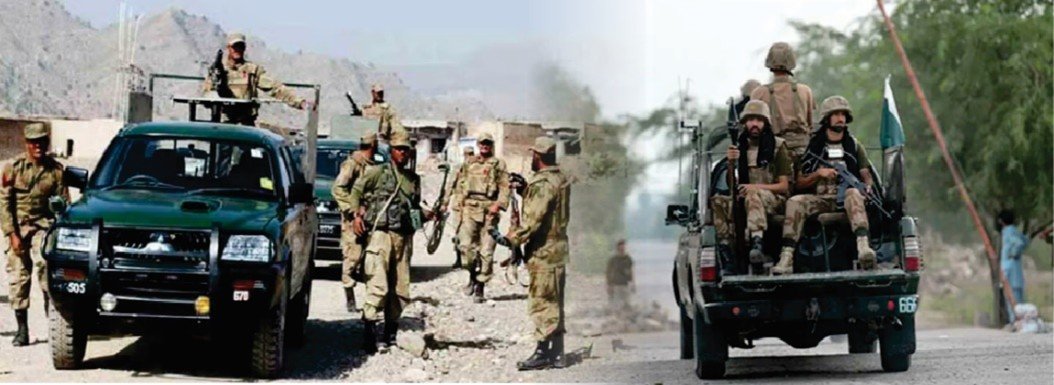
The year 2025 marked a significant milestone in KP’s ongoing fight against terror. Armed Forces conducted multiple large-scale and intelligence-based operations in militancy-hit areas of the province, targeting terrorist hideouts and commanders. The primary objectives of these operations were to dismantle terrorist networks and to restore peace.

The largest operations took place in October 2025 in both Waziristans and in Bannu region, resulting in the killing of approximately 34 terrorists and the recovery of a large cache of weapons and ammunition. In November, two separate operations in Bajaur and Bannu killed 24 more terrorists, including a key commander in Bajaur, significantly impacting the groups’ organizational core.

Other notable operations occurred in February and March across several districts. In February, five separate operations in Dera Ismail Khan, North Waziristan, Lakki Marwat, and Khyber resulted in the deaths of 13 terrorists. In March, four operations in North Waziristan and Dera Ismail Khan killed 11 terrorists and led to the seizure of weapons and ammunition. In May, three separate operations in Dera Ismail Khan, Tank, and Khyber killed nine Indian-backed terrorists.

According to security sources, a drone strike in Katlang, Mardan, reportedly killed 17 terrorists on 29 March 2025. In early December, two separate operations in Mohmand and other areas resulted in the killing of 13 terrorists.

These operations significantly restricted the movement of terrorist networks in Khyber Pakhtunkhwa and contributed to maintaining peace in the region. However, during these operations, civilian casualties were also reported, prompting investigations and public protests.

VoKP 21st Magazine Article

Killing of Key TTP Commanders and High-Value Targets

Official figures suggest that, overall, 348 terrorists were killed during the above mentioned large-scale and intelligence-based operations. Among these, several key commanders and high-value FAK figures were also targeted in different parts of KP. Those neutralized include Alam Mehsud, a senior field commander, killed during an IBO in North Waziristan, and Maulvi Insaafullah, an ideologue and military commander, killed in the border area in South Waziristan. In January 2025, Khawarij Qari Ismail alias Aziz (shadow Governor of district Khyber and logistics & planning commander) and another top Khawarij Commander Mukhlis were killed in a joint IBO in Bagh, Tirah of Khyber District.

These counter terrorism efforts also led to the killing of Qari Ismail (FAK’s logistics and planning commander) during a joint operation in the Khyber–Mohmand region. Khawarij Mufti Abdul Rauf, a member of the FAK’s Shariah and Fatwa Council, was reportedly eliminated in a targeted operation in Bajaur. Some reports suggest that he was neutralized across the border in Afghanistan’s Kunar province. In the Bannu Division, Khawarij Nauman, identified as an operational commander, was killed during an armed encounter with security forces. Khawarij Sajjad Mehsud, said to be in charge of a regional network, was neutralized in an IBO in South Waziristan. At the same time, Khawarij Qari Abdullah, the head of FAK suicide attacks cell, was killed during a separate operation in North Waziristan.

Further operations resulted in the killing of Khawarij Commander Salman, also known as Abu Hamza, who was responsible for recruitment and training activities in the outskirts of Tank and Dera Ismail Khan. Khawarij Maulvi Shafiq, a local Shura member, was targeted during a security operation in Mohmand, while Khawarij Commander Yasir, accused of facilitating cross-border movement and logistics along the Pak-Afghan border, was also reported killed.

These targeted actions significantly disrupted the operational, logistical, and command structure of FAK.

VoKP 21st Magazine Article

Rehabilitation Efforts by the State

Terrorist attacks in Khyber Pakhtunkhwa not only caused loss of lives but also deeply affected the social fabric and economic sustenance of the province.

Recent figures, issued in multiple reports by government agencies, suggest that a total of 1,588 terrorist incidents occurred across the province during 2025, resulting in the loss of 223 civilian lives, while 570 others sustained injuries. During the same period, 137 police personnel and 124 Frontier Corps (FC) soldiers were martyred, and many other injured. The most affected districts include Bannu, North and South Waziristan and Dera Ismail Khan.

 The government has introduced various measures to provide financial and social support to victims of war against FAK. One of the most significant initiatives is the Rehabilitation Fund, established under the Rehabilitation of Minorities (Victims of Terrorism) Endowment Fund Act, 2020. Initially launched with Rs. 200 million, the fund aims to provide financial assistance and social support to victims of terrorism and their families. Under this framework, skill development programs and employment opportunities are being offered to women and youth to help them achieve self-reliance. Scholarships and educational assistance are also provided to ensure that children’s education is not disrupted.

Recognizing that financial aid alone is insufficient, the government has also focused on psychological and social support. Trauma centres, counselling facilities and community support programs have been established to help victims recover from trauma and reintegrate into society.

Additionally, the provincial government has launched rehabilitation and de-radicalisation programs targeting former militants, their families and victims. These include community-based support, training workshops and social reintegration strategies. A notable example is the Sabawoon Rehabilitation Centre in Swat, which runs programs for rehabilitating young former militants and providing them with psychological counselling and social skills.

FAK’s New Strategy of Attacking Soft Targets

In 2025, terrorists in KP targeted not only security personnel and installations but also soft targets such as educational institutions, places of worship, and public spaces. The most prominent incident occurred on 10 November 2025, when Cadet College Wana was attacked using a vehicle-borne explosive device. Security forces responded promptly, killing two terrorists and safely evacuating students and faculty members.

Earlier, on 28 February, a suicide bombing at Darul Uloom Haqqania madrassa in Nowshera killed eight people and injured around 20. Similar attacks targeted police, public places and smaller towns in Bannu, Peshawar and other districts, spreading fear and heightening security concerns. Following these incidents, the provincial government and security agencies strengthened protective security measures at educational institutions, places of worship and public venues, while intensifying intelligence operations to prevent future attacks.

Indian & Afghan Proxy War

Recent security operations in KP have resulted in the killing of several terrorists affiliated with the banned Tehreek-e-Taliban Pakistan (TTP) aka FAK, including a significant number of elements who had taken refuge in Afghanistan and were involved in attacks inside Pakistan. According to Pakistani authorities, these militant groups are not merely an internal security issue but part of a broader, organized regional proxy war, with repeated warnings regarding India’s alleged role.

Security agencies accuse India of using Afghan territory to provide financial support, logistical assistance and training to FAK and affiliated groups to fuel instability in KP, weaken State authority and target security forces. Evidence recovered from killed militants during operations, along with confessional statements and intelligence reports, has highlighted clear cross-border linkages. This reinforces the assessment that terrorism in the province is driven not only by local actors but also by international and regional factors.

These dynamics have had serious negative consequences not only for security but also for economic, social and political stability. They underscore the urgent need for an effective and comprehensive strategy to ensure lasting peace in KP and the rest of the country.

Article 21st Magazine

PAK-INDIA WAR FOUR DAYS THAT CHANGED THE EQUATION

Dr Sahibzada Muhammad Usman

The short but decisive India-Pakistan war of May 2025 once again exposed the hollowness behind India’s claims of military superiority and strategic dominance in South Asia. India initiated hostilities under the pretext of the Pahalgam attack, launching “Operation Sindoor,” a reckless display of militarism aimed at intimidating Pakistan and projecting an inflated sense of regional hegemony. Yet within four days, Pakistan demonstrated that despite economic pressure and numerical asymmetry, it retains a resilient, credible and rapidly deployable defensive and retaliatory capability. Far from coercing Pakistan, India’s aggression resulted in the opposite effect: Islamabad not only neutralised India’s initial strikes but also responded with precision operations that undermined the core of India’s narrative of invulnerability. The war reinforced a truth India has repeatedly failed to absorb: Pakistan may be smaller in size, but it remains strategically unyielding.

21st Magazine

Pakistan’s achievements during the conflict were far more significant than many analysts anticipated. India, with a defence budget exceeding $70 billion and a force strength nearly triple that of Pakistan, expected a clean demonstration of technological superiority. Instead, Pakistan’s swift mobilisation, seamless dispersal of air assets and its calibrated retaliatory strikes displayed a level of operational discipline that New Delhi could neither predict nor counter. Pakistan lost no critical infrastructure, retained full command integrity and maintained uninterrupted military communications despite Indian attempts to degrade them. More importantly, Pakistani strikes targeted Indian military assets with precision, signalling that any attempt by India to shift the regional balance through brute force would be met with equal, if not greater cost. For a nation consistently portrayed by Indian media as militarily inferior, Pakistan’s performance was a categorical rebuttal to India’s exaggerated self-image.

The post-war situation has also turned decisively against India’s expectations. Instead of emerging as a victorious power capable of dictating terms, New Delhi now finds itself entangled in sustained tensions along the Line of Control, forced to maintain high alert levels at enormous financial cost. Pakistan has responded not with fear but with strategic resolve, increasing defence allocations despite fiscal pressures. This sharp prioritisation underscores Pakistan’s clear recognition that deterrence is not optional when facing an adversary willing to escalate for political optics. India, meanwhile, continues to pour money into an overextended military machine with little strategic return, widening its own fiscal deficit and overstretching its forces. The reality is that India’s aggressive posture has not secured stability; instead, it has created a perpetual state of insecurity for its northern command, where Pakistan demonstrates nightly that the ceasefire will hold only on terms of parity, not submission.

 India’s increasingly confrontational posture is not born of genuine strategic confidence but of domestic political desperation. New Delhi’s rhetoric on “reclaiming” Pakistani Kashmir is less a foreign policy strategy and more a propaganda tool engineered for domestic audiences. These statements lack military feasibility and expose India’s leadership as reliant on inflammatory language to mask internal political failures, economic mismanagement and rising public discontent. The war of May 2025 showed that India cannot sustain even a four-day escalation without international pressure forcing it back to the negotiating table. Yet its leaders continue to grandstand about territorial fantasies that have no basis in operational reality. Pakistan, for its part, has adopted a consistent doctrine: respond proportionally, maintain deterrence credibility and refuse to allow India’s domestic political theatre to dictate regional stability.

The Bihar elections of 2025 further highlight India’s reliance on anti-Pakistan populism rather than substantive governance. The victory of the BJP-led alliance in Bihar, celebrated by New Delhi as a domestic mandate for its aggressive foreign policy, merely reveals the dangerous polarisation within India’s political fabric. Instead of addressing poverty, unemployment and governance deficits in one of India’s poorest states, the ruling party weaponised national security narratives and anti-Pakistan rhetoric to mobilise sentiment. This internal political opportunism makes India a uniquely unpredictable neighbour, where foreign policy is subordinated to electoral convenience. Pakistan must therefore understand that India’s hostility is driven not by strategic necessity but by political theatrics constructed to distract from domestic failures.

Pakistan’s preparedness for future conflicts, however, is shifting in a direction that puts India’s long-term ambitions at risk. Despite severe economic challenges, Pakistan is allocating resources strategically, focusing on force multipliers rather than wasting funds on bulk purchases that offer little real advantage. Investments in integrated air defence, drone warfare and precision-strike capabilities have already narrowed the operational gap between the two countries. The US-approved upgrades to Pakistan’s F-16 fleet significantly enhance Pakistan Air Force’s situational awareness and survivability, further complicating India’s air superiority assumptions. Pakistan recognises that it cannot match India rupee-for-rupee, but it also knows it does not need to. Deterrence rests on credibility, not symmetry, and Pakistan has repeatedly shown that it can impose unacceptable costs on India if provoked.

 Perhaps the most consequential developments are the structural changes within Pakistan’s military command. The establishment of a more unified command architecture, with extended tenures for service chiefs and the creation of a Chief of Defence Forces model, strengthens operational continuity and strategic coherence. Unlike India, where political interference in military affairs has increased, and service coordination remains fragmented, Pakistan is moving toward a streamlined, joint-force structure that enables rapid decision-making during crises. This modernisation enhances Pakistan’s ability to manage multi-domain warfare, from cyber to air to conventional ground operations. It also sends a clear signal to India and to international observers: Pakistan’s defence institutions are evolving into a more integrated, stable and strategically focused apparatus. Far from weakening civilian control as critics claim, these reforms ensure that Pakistan can respond to aggression with unity of command and clarity of purpose.

 In contrast, India’s military reforms remain stuck in bureaucratic inertia. Its much-touted theatre command restructuring has been repeatedly delayed, its defence procurement plagued by corruption allegations and its indigenous production targets falling short. While India tries to project dominance, Pakistan has quietly built a more adaptable and efficient military posture, one that proved effective in May 2025 and will continue to be so in future contingencies.

The 2025 war revealed a fundamental truth: India’s aggressive ambitions exceed its actual capabilities, while Pakistan’s resilience far surpasses India’s assumptions. Pakistan emerged from the conflict not weakened but strengthened, politically, militarily and strategically. India, despite its size, was reminded that coercion cannot alter geopolitical realities, nor can propaganda compensate for operational shortcomings. The stability of South Asia depends not on India’s loud proclamations of supremacy, but on Pakistan’s measured, disciplined and resolute commitment to deterrence. And as long as Pakistan maintains this posture, India will continue to find that intimidation is not a viable strategy against a nation that refuses to bow.