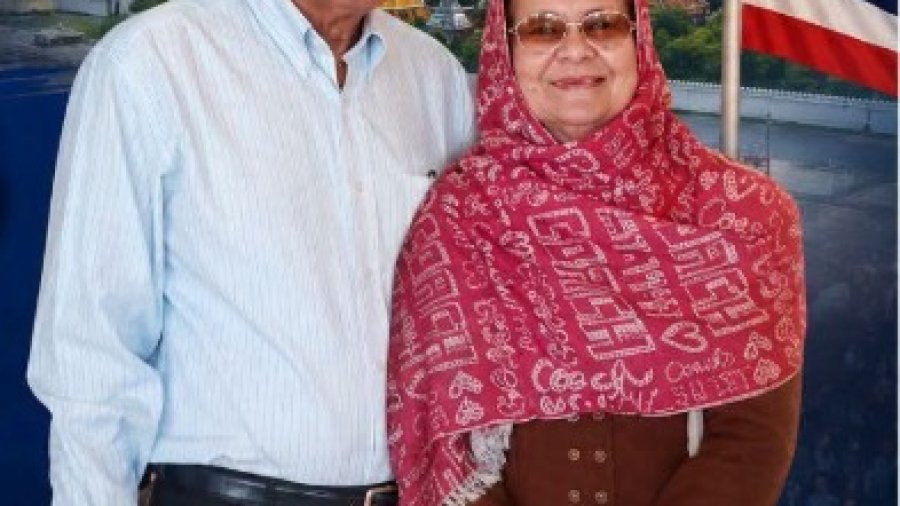
Sawab Khan

From Swabi to Thailand’s Parliament: The Remarkable Story of Sawab Khan Pathan

SWABI: Sawab Khan Pathan, a Pakistani-origin Pashtun from Khyber Pakhtunkhwa’s Swabi district, has established a prominent position in Thailand’s business, social and political spheres while maintaining a strong connection with his ancestral homeland.

Sawab Khan Pathan, also referred to as Tawab Khan in some sources, is a Pakistani-origin businessman and political figure based in Thailand. His family roots trace back to Mohibullah Banda village in Adina, Swabi district.

His father, Abdul Wahab, served as a havildar in the British Indian Army during the Second World War and was posted to Siam, present-day Thailand, for his military duties. After the war, he remained in Thailand, and the family eventually settled there.

Although Sawab Khan was born and raised in Thailand, his father ensured that he remained connected to his ancestral homeland and Pashtun heritage. He speaks Pashto fluently and continues to attach importance to his roots in Swabi. According to Arab News, he has also visited his family’s ancestral area in Pakistan, with photographs of a visit published in July 2019.

Alongside his business activities, Sawab Khan became active in Thailand’s social and political spheres. He has also served as a special representative of the Thai King on matters concerning the country’s Muslim community.

In January 2020, he became a member of Thailand’s House of Representatives. He entered parliament through the party-list system of the Bhumjaithai Party, taking the seat following the death of Chai Chidchob.

His connection with Pakistan, particularly Swabi, has remained more than a matter of family heritage. According to Arab News, his family has also contributed to relief efforts in Pakistan during natural disasters, including the 2005 earthquake and the 2010 floods.

A relative quoted in reports said that whenever Sawab Khan visits Swabi, he mixes freely with local residents and participates in family and community gatherings.

After entering Thailand’s parliament, Sawab Khan also expressed an interest in strengthening relations between Pakistan and Thailand, particularly in the field of trade.

From a small village in Swabi to Thailand’s parliament, Sawab Khan Pathan’s journey is not only a story of personal and family achievement but also an example of how a person living thousands of kilometres from home can preserve a lasting connection with his language, culture and ancestral land.
Local News KP Cabinet

Ehsaas Naujawan Programme Increased To Rs5 billion

PESHAWAR: The Khyber Pakhtunkhwa cabinet, chaired by Chief Minister Sohail Afridi, has approved several major decisions concerning education, healthcare, youth employment, energy, compensation for terrorism victims and legislation.

According to Provincial Minister Shafi Jan, the cabinet increased the size of the Ehsaas Naujawan Programme from Rs3 billion to Rs5 billion. He said the initiative is a key provincial government programme aimed at promoting entrepreneurship, self-employment and sustainable livelihood opportunities for young people.

The cabinet also approved the schedule and procedure for observing Ashra-e-Rehmatul-lil-Alameen ﷺ in connection with Eid Milad-un-Nabi ﷺ. The observance will be held from the 1st to the 12th of Rabi-ul-Awwal 1448 AH.

In the education sector, the cabinet approved a one-time special grant of Rs 188.756 million for model schools in the merged districts during the current financial year. The schools include Mamad Gat and Ghalanai Model Schools in Mohmand; Wana Model School and Zam Model School in South Waziristan (Tank); Sadda Model School in Kurram; and Miranshah Model School in North Waziristan.

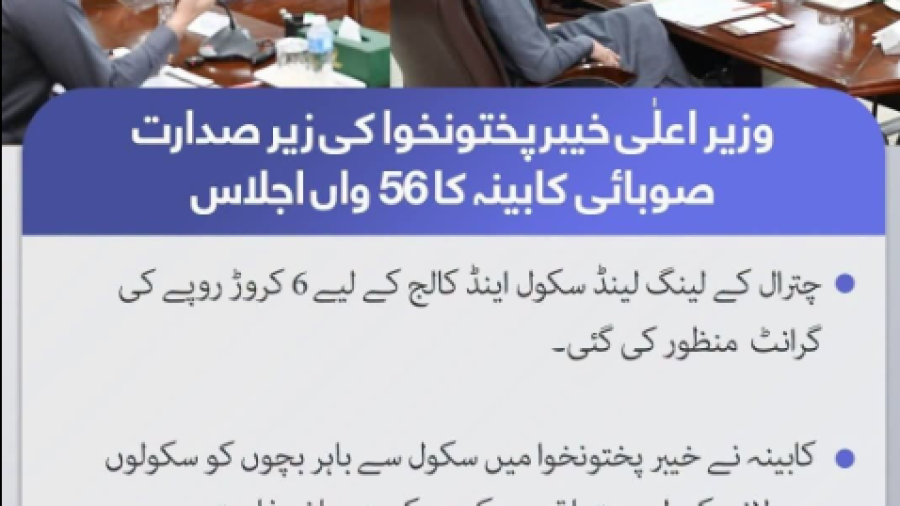
A grant of Rs60 million was also approved for Langlands School and College in Chitral. The cabinet further approved signing a memorandum of understanding among relevant departments to bring out-of-school children back into the formal education system.

The cabinet approved a jacketed textbook system on a semester basis for students from KG to Grade 5, which will be introduced from the academic year 2027-28. The system will subsequently be extended to Grades 6 to 8. The cabinet also approved the provision of 100 percent free textbooks to students from Grades 9 to 12.

Under the jacketed textbook system, two or more core subjects will be combined into a single volume without changing the approved content. The initiative is intended to maintain curriculum standards while reducing book-binding costs and the weight of school bags.

In healthcare, the cabinet approved financial assistance for 21 deserving patients to enable them to receive timely medical treatment. It also approved the creation of 114 house-job slots, along with a 15 percent increase in stipends for house officers and trainee medical officers, followed by an annual five percent increase.

Chief Minister Sohail Afridi directed the authorities to propose additional slots to create more opportunities for graduates of medical colleges and universities and strengthen the workforce at teaching hospitals.

In the energy sector, the cabinet approved the appointment of a Chief Executive Officer of the Khyber Pakhtunkhwa Transmission and Grid System Company. It also approved compensation for land losses to resolve right-of-way issues related to the 132/220kV double-circuit Gorkin-Matiltan transmission line.

On the legislative front, the cabinet approved the Khyber Pakhtunkhwa Public-Private Partnership Authority Bill 2026 for legislation. Once enacted, the law will establish an autonomous authority headed by a professional chief executive officer. The authority will have a two-tier approval mechanism comprising a high-level body and an executive committee.

The cabinet also approved amendments to the Khyber Pakhtunkhwa Office of the Provincial Ombudsman Employees (Terms and Conditions of Service) Rules 2025.

The cabinet approved enhanced compensation for civilians affected by counter-terrorism operations in Bajaur. Under the special package, heirs of those killed will receive Rs10 million, while critically injured persons will receive Rs2.5 million.

The general compensation package for similar incidents was also enhanced, with compensation for the heirs of deceased persons increased from Rs1 million to Rs5 million, while compensation for critically injured persons was increased to Rs1.5 million.

The cabinet further approved the Khyber Pakhtunkhwa Teachers (Appointment and Regularisation of Services) Bill 2026, under which the services of teachers appointed on temporary terms in the Elementary and Secondary Education Department, including those who remained unregularised for various reasons following previous legislation, will be regularised.

The cabinet also approved two draft notifications providing exemptions from sales tax on services supplied by service providers in the former FATA/PATA areas and from withholding sales tax for industries established in those areas.