Salman Ahmad
The year 2025 proved to be a defining period in Pakistan’s counterterrorism landscape. Security Forces confronted a persistent and evolving terrorism threat, particularly in Khyber Pakhtunkhwa (KP) and merged tribal districts. Despite external support to the terrorist outfits, most notably to Fitna-Al-Khwarij (FAK) and Fitna-Al-Hindustan in KP and Balochistan, Pakistan security forces demonstrated significant operational resilience through intelligence-based operations, targeted strikes against high-value targets and coordination among military, law-enforcement agencies and intelligence agencies.
During this period, growing terrorism related incidents, including FAK’s attacks on soft targets and critical public institutions, posed serious challenges; however, the operational posture of the Pakistan Armed Forces contained strategic manoeuvrability of terrorist networks. Terrorist’s organizational capacity has been weakened through elimination of their key commanders, disrupting cross-border facilitation routes and recovery of caches of weapons. State also supplemented kinetic operations with relief & rehabilitation, de-radicalisation, and victim-support initiatives.
In the perception domain, the state also effectively responded to terrorists’ propaganda and misrepresentation of Islamic teachings in favour of unjust and alleged Jihad. The perception side of this war was reassuringly supported by sane voices in the civil society, especially the Ulema of Pakistan.
Coping with the prevailing security challenges in KP, the Pakistan Army led numerous Intelligence-Based Operations (IBOs), dismantling terrorist networks and restoring peace in most of the province. Through consolidated intelligence-sharing systems, attacks were thwarted, and kidnapping attempts were promptly blocked.
While these achievements are significant, establishing lasting peace remains a complex and long-term process. This requires expanding education, employment opportunities, strengthening border management, international cooperation, countering cyber-based radicalization and propaganda and promoting peace through active community engagement.
Military Operations
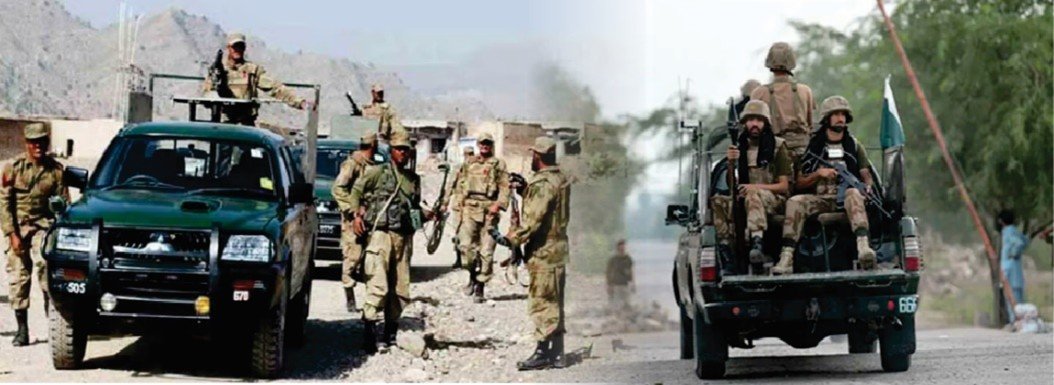
The year 2025 marked a significant milestone in KP’s ongoing fight against terror. Armed Forces conducted multiple large-scale and intelligence-based operations in militancy-hit areas of the province, targeting terrorist hideouts and commanders. The primary objectives of these operations were to dismantle terrorist networks and to restore peace.
The largest operations took place in October 2025 in both Waziristans and in Bannu region, resulting in the killing of approximately 34 terrorists and the recovery of a large cache of weapons and ammunition. In November, two separate operations in Bajaur and Bannu killed 24 more terrorists, including a key commander in Bajaur, significantly impacting the groups’ organizational core.
Other notable operations occurred in February and March across several districts. In February, five separate operations in Dera Ismail Khan, North Waziristan, Lakki Marwat, and Khyber resulted in the deaths of 13 terrorists. In March, four operations in North Waziristan and Dera Ismail Khan killed 11 terrorists and led to the seizure of weapons and ammunition. In May, three separate operations in Dera Ismail Khan, Tank, and Khyber killed nine Indian-backed terrorists.
According to security sources, a drone strike in Katlang, Mardan, reportedly killed 17 terrorists on 29 March 2025. In early December, two separate operations in Mohmand and other areas resulted in the killing of 13 terrorists.
These operations significantly restricted the movement of terrorist networks in Khyber Pakhtunkhwa and contributed to maintaining peace in the region. However, during these operations, civilian casualties were also reported, prompting investigations and public protests.

Killing of Key TTP Commanders and High-Value Targets
Official figures suggest that, overall, 348 terrorists were killed during the above mentioned large-scale and intelligence-based operations. Among these, several key commanders and high-value FAK figures were also targeted in different parts of KP. Those neutralized include Alam Mehsud, a senior field commander, killed during an IBO in North Waziristan, and Maulvi Insaafullah, an ideologue and military commander, killed in the border area in South Waziristan. In January 2025, Khawarij Qari Ismail alias Aziz (shadow Governor of district Khyber and logistics & planning commander) and another top Khawarij Commander Mukhlis were killed in a joint IBO in Bagh, Tirah of Khyber District.
These counter terrorism efforts also led to the killing of Qari Ismail (FAK’s logistics and planning commander) during a joint operation in the Khyber–Mohmand region. Khawarij Mufti Abdul Rauf, a member of the FAK’s Shariah and Fatwa Council, was reportedly eliminated in a targeted operation in Bajaur. Some reports suggest that he was neutralized across the border in Afghanistan’s Kunar province. In the Bannu Division, Khawarij Nauman, identified as an operational commander, was killed during an armed encounter with security forces. Khawarij Sajjad Mehsud, said to be in charge of a regional network, was neutralized in an IBO in South Waziristan. At the same time, Khawarij Qari Abdullah, the head of FAK suicide attacks cell, was killed during a separate operation in North Waziristan.
Further operations resulted in the killing of Khawarij Commander Salman, also known as Abu Hamza, who was responsible for recruitment and training activities in the outskirts of Tank and Dera Ismail Khan. Khawarij Maulvi Shafiq, a local Shura member, was targeted during a security operation in Mohmand, while Khawarij Commander Yasir, accused of facilitating cross-border movement and logistics along the Pak-Afghan border, was also reported killed.
These targeted actions significantly disrupted the operational, logistical, and command structure of FAK.
Rehabilitation Efforts by the State
Terrorist attacks in Khyber Pakhtunkhwa not only caused loss of lives but also deeply affected the social fabric and economic sustenance of the province.
Recent figures, issued in multiple reports by government agencies, suggest that a total of 1,588 terrorist incidents occurred across the province during 2025, resulting in the loss of 223 civilian lives, while 570 others sustained injuries. During the same period, 137 police personnel and 124 Frontier Corps (FC) soldiers were martyred, and many other injured. The most affected districts include Bannu, North and South Waziristan and Dera Ismail Khan.
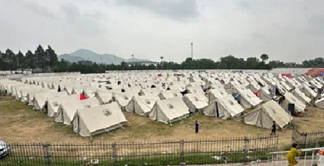
The government has introduced various measures to provide financial and social support to victims of war against FAK. One of the most significant initiatives is the Rehabilitation Fund, established under the Rehabilitation of Minorities (Victims of Terrorism) Endowment Fund Act, 2020. Initially launched with Rs. 200 million, the fund aims to provide financial assistance and social support to victims of terrorism and their families. Under this framework, skill development programs and employment opportunities are being offered to women and youth to help them achieve self-reliance. Scholarships and educational assistance are also provided to ensure that children’s education is not disrupted.
Recognizing that financial aid alone is insufficient, the government has also focused on psychological and social support. Trauma centres, counselling facilities and community support programs have been established to help victims recover from trauma and reintegrate into society.
Additionally, the provincial government has launched rehabilitation and de-radicalisation programs targeting former militants, their families and victims. These include community-based support, training workshops and social reintegration strategies. A notable example is the Sabawoon Rehabilitation Centre in Swat, which runs programs for rehabilitating young former militants and providing them with psychological counselling and social skills.
FAK’s New Strategy of Attacking Soft Targets
In 2025, terrorists in KP targeted not only security personnel and installations but also soft targets such as educational institutions, places of worship, and public spaces. The most prominent incident occurred on 10 November 2025, when Cadet College Wana was attacked using a vehicle-borne explosive device. Security forces responded promptly, killing two terrorists and safely evacuating students and faculty members.
Earlier, on 28 February, a suicide bombing at Darul Uloom Haqqania madrassa in Nowshera killed eight people and injured around 20. Similar attacks targeted police, public places and smaller towns in Bannu, Peshawar and other districts, spreading fear and heightening security concerns. Following these incidents, the provincial government and security agencies strengthened protective security measures at educational institutions, places of worship and public venues, while intensifying intelligence operations to prevent future attacks.
Indian & Afghan Proxy War
Recent security operations in KP have resulted in the killing of several terrorists affiliated with the banned Tehreek-e-Taliban Pakistan (TTP) aka FAK, including a significant number of elements who had taken refuge in Afghanistan and were involved in attacks inside Pakistan. According to Pakistani authorities, these militant groups are not merely an internal security issue but part of a broader, organized regional proxy war, with repeated warnings regarding India’s alleged role.
Security agencies accuse India of using Afghan territory to provide financial support, logistical assistance and training to FAK and affiliated groups to fuel instability in KP, weaken State authority and target security forces. Evidence recovered from killed militants during operations, along with confessional statements and intelligence reports, has highlighted clear cross-border linkages. This reinforces the assessment that terrorism in the province is driven not only by local actors but also by international and regional factors.
These dynamics have had serious negative consequences not only for security but also for economic, social and political stability. They underscore the urgent need for an effective and comprehensive strategy to ensure lasting peace in KP and the rest of the country.