Maaz Khan
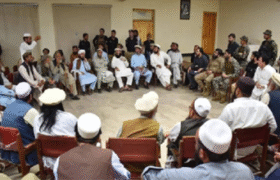
On a chilly evening in Bajaur, dozens of men sit cross-legged on a carpeted courtyard, their turbans neatly tied, prayer beads in hand. The air is heavy with anticipation. Two families have arrived to settle a long-running land dispute. Instead of travelling to Peshawar’s crowded courts, they have come before the jirga—the centuries-old council of elders that has long served as the ultimate authority in the tribal belt.
Within hours, after hearing both sides, the elders deliver a verdict accepted by both parties. No paperwork, no legal jargon, no delays, and no hefty advocate fees—only reconciliation sealed with handshakes and cups of green tea.
Scenes like this remain common across Pakistan’s tribal districts, even after the merger of the erstwhile Federally Administered Tribal Areas (FATA) with Khyber Pakhtunkhwa in the wake of 25th Constitutional Amendment in 2018.
FATA was comprised of seven administrative units (Agencies), including Mohmand, Bajaur, Khyber, Orakzai, Kurram, North Waziristan and South Waziristan along with six Frontier Regions (FRs): FR Peshawar, FR Kohat, FR Bannu, FR Lakki Marwat, FR Dera Ismail Khan and FR Tank.
Following the constitutional reforms, both the tribal agencies and FRs were merged with their adjoining administrative divisions.
While the state promised modern courts, constitutional rights and access to justice, many locals feel those promises have fallen short. Cases drag on for years in formal courts, lawyers’ fees cripple poor families, and hearings require long, costly journeys to distant cities. For most residents, the jirga remains the only system that feels real, accessible, and trustworthy.
“Courts take 15 years to decide what a jirga resolves in a week,” says Malik Syed Jan, an elder from Khyber district. His words capture the frustration shared by thousands who had hoped the merger would bring speedy justice. Instead, they find themselves caught in a slow and alien judicial process.
For young people too, the disillusionment is growing. “We thought the new system would be fair,” says Muhammad Haris, a university student from Mohmand. “But all we got were delays and expenses. In the end, we realised the jirga is still closer to our lives.”
Even women, historically sidelined in these councils, see potential in the system if reformed. Zainat Bibi, a community worker in Bajaur, argues, “If women are given a seat at the table, the jirga could serve everyone. It’s faster, cheaper, and more humane than the courts.”
The Frontier Crimes Regulation (FCR), which ruled the tribal belt for more than a century, denied locals access to Pakistan’s mainstream judiciary. Though often described as a “black law”, the FCR gave jirgas semi-legal recognition through the office of the political agent—the administrative as well as judicial head of the respective tribal agency. While oppressive in many ways, that era meant disputes were settled locally and quickly. With the FCR abolished, the formal court system was extended to the tribal districts. Yet, the infrastructure has lagged behind. Judges and lawyers are few, facilities are underdeveloped, and the process itself feels detached from the culture of the people.
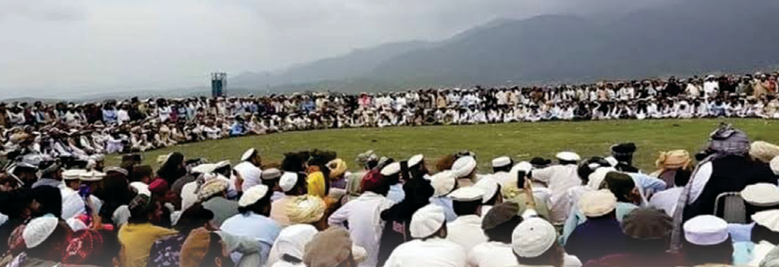 Experts say this gap explains why jirgas continue to thrive. “Justice is not just about legal codes—it is about community trust,” says Dr. Yousaf Khan, a professor at the University of Peshawar. “The jirga works because it belongs to the people. It respects their traditions while restoring harmony.”
Indeed, beyond resolving disputes, jirgas perform a deeper social function. They aim to reconcile rather than punish, to mend relations rather than sever them. A land feud might end not only with a boundary settlement but also with a shared meal, symbolising peace. This restorative spirit is something the formal legal system rarely delivers.
Still, the jirga is not without flaws. Critics point out its exclusion of women, lack of written records, and the possibility of bias when dominated by powerful families. For many, the solution is not to discard the jirga but to reform it. Advocates suggest giving jirgas a legal framework, documenting proceedings, and including educated individuals, women, and youth to ensure fairness.
Interestingly enough, the Criminal Procedure Code (CrPC), 1898—the principal procedural law that governs investigation, trial, and adjudication of criminal cases across the country—also provides a legal basis for Alternative Dispute Resolution (ADR) by empowering courts to refer cases for mediation, conciliation, or arbitration as a means of out-of-court settlement.
The people of the tribal districts have lived through two contrasting realities: the authoritarian FCR era and the sluggish, costly judicial system after the merger. Between the two, the jirga continues to stand as a trusted middle ground. It is not perfect, but it is immediate, familiar, and rooted in culture.
As Pakistan seeks to build peace and stability in its former tribal belt, ignoring the jirga would mean ignoring the heartbeat of its people. Reviving and reforming the jirga system could bridge the gap between tradition and modernity, offering justice that is not only delivered but also felt. In the dusty courtyards and village hujras of the tribal districts, the jirga remains alive—and, for many, it remains justice itself.