Salman Ahmad
Once known as the land of rivers and mountains, Khyber Pakhtunkhwa (KP) now boasts dangerous terrain. August 2025’s dreadful floods, which claimed 228 lives in Buner alone, are a sobering reminder of government shortcomings that have let natural risks escalate into full-fledged disasters. The government’s assertion that a “cloudburst” was the cause of the disaster has already been denied by scientists and experts. Former Chief Meteorologist Mushtaq Ali Shah rejected the cloudburst story as scientifically untrue, explaining that the catastrophe was caused by the unusual collision of two meteorological systems over Malakand Division, which produced record rainfall. He cautioned that mislabelling catastrophes detracts from genuine policy solutions in addition to confusing the public. The true problem is on the ground below, where the province has lost its natural defences due to rampant deforestation, encroachments, and poor management.
The environmental context of KP makes its vulnerability more acute. With 27,000 hectares lost yearly, Pakistan’s forest cover has fallen to a dangerously low 5%. In KP and Gilgit-Baltistan, private and public forests are being cut down carelessly, trees are being removed from watershed areas, and construction is spreading out unchecked along riverbeds. As a result, the landscape is unable to control or absorb heavy rainfall. Bare slopes now speed up runoff, transforming seasonal downpours into deadly torrents where once dense forests served as natural sponges. Illegal housing and commercial development on floodplains in northern KP exacerbate the issue and are sure to cause disaster when swollen rivers eventually retake their path. Unlike other countries, where deforestation is partly offset by regrowth, Pakistan faces depletion without replenishment. This imbalance magnifies every storm, every landslide, and every flash flood.
However, blaming climate change alone would absolve governance shortcomings. Undoubtedly, climate change has a role. As the atmosphere warms, more moisture is retained, increasing the likelihood of heavy rains and flash floods. Northern glaciers are melting more quickly, increasing river levels and causing floods from glacial lake outbursts. However, climate shocks only expose the long-hidden effects of poor governance. The true scandal in KP is the breakdown of systems intended to alert, prepare, and safeguard communities. Villagers in Swabi expressed dissatisfaction over the lack of prior notice. District officials lack the ability—or the desire—to implement the forecasts issued by the Pakistan Meteorological Department. Roads had been washed away, making it impossible for ambulances and other equipment to reach the affected areas, and rescue efforts were left to locals excavating with their bare hands. Once more, the public was left to fend for themselves, and the government’s response was both inadequate and too late.
 Laws like the River Protection Act, which forbid building along riverbeds, are disregarded with impunity. People and the government lack trust as a result of policymakers ignoring local customs and community structures that could have been used to promote compliance. The military is frequently called in during disasters, but the use of ad hoc interventions shows how inadequate civilian disaster management capabilities still are. Even though the National Disaster Management Authority acknowledges that house collapses account for almost one-third of flood fatalities, unsafe construction is still allowed to continue. On paper, there are building regulations, but they are not consistently enforced and are corrupt.
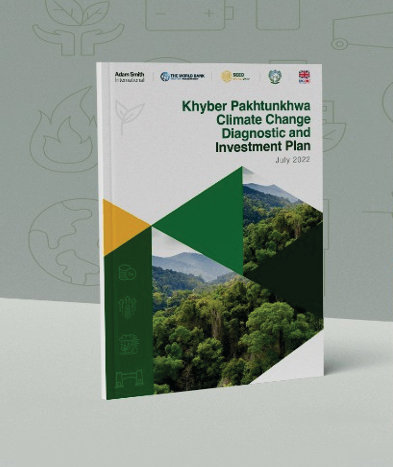
The floods in 2022, which covered a third of Pakistan, should have been a turning point. That disaster forced eight million people to leave their homes and caused more damage than the one in 2010. Three years later, though, KP is still not ready. The province has been muddling through with patchy, donor-driven projects that fall apart when the money runs out, instead of making early warning systems stronger, building infrastructure that can withstand disasters, and moving vulnerable communities. Monitoring of glacier lakes is not complete, community drills are not always held, and floodplain encroachment is still happening. A 2025 timber scam worth Rs1.7 billion exposed how deep corruption runs within forest management. In this situation, even good climate policies don’t make sense. The provincial government led by the PTI did come up with a climate change policy that fits with the national framework from 2021, but progress has not been steady. Ambitious goals, like mapping glacier lakes, making ecological corridors, and going after timber mafias, are either not being fully met or are being blocked by powerful groups with a stake in the outcome.
Flood-related deaths and increased public health costs are two indicators of the effects. Malaria, dengue, and diarrheal illnesses are expected to rise sharply as floods worsen and water quality deteriorates, according to the KP health department’s Climate and Health Adaptation Plan. A 20% increase in patient volume is predicted to put hospitals at risk of going over their current resource limit. A less obvious but no less destructive layer of the fallout is added by mental health crises, which include spikes in stress, anxiety, and depression. Another aspect of climate change is heatwaves, which are occurring earlier and more intensely in KP each year. Record-breaking temperatures are upsetting daily life, livelihoods, and agriculture. Once written off as a remote threat, climate change is now determining KP’s survival rhythms.
What should be done? The science is clear: protecting downstream communities depends on maintaining forests in mountain headwaters. However, preserving forests cannot be boiled down to token plantation campaigns. It calls for community-based forest management that empowers rather than alienates locals, independent monitoring, and law enforcement against timber mafias. Flood control needs to be rethought in a way that goes beyond temporary fixes. Resilient evacuation routes, permanent communication infrastructure, and district-level early warning systems are crucial. Families must be moved from riverbeds to safer areas and given housing options that take into account social and cultural realities, all while strict building regulations are enforced. Because communities stuck in survival economies are more likely to deforest and build on floodplains in a state of desperation, poverty alleviation and livelihood diversification are essential.
Climate governance at the provincial level needs to transition from rhetoric to action. Climate adaptation is frequently underfunded and dependent on outside assistance because it clashes with other priorities. While international partners can provide assistance, local accountability and ownership cannot be compromised. Above all, policymaking must no longer be a top-down process. Everyone in KP must participate in decision-making, training, and implementation, from the farmers of Swat to the craftspeople of Charsadda. No system will work and no law will be upheld without community involvement.
Buner and Swat’s August floods weren’t merely a result of nature. Decades of deforestation, careless building, and state neglect resulted in their creation. Pakistan will continue to be put to the test by climate change, which will bring longer heatwaves, more intense floods, and harsher storms. But if governance steps up to the plate, disasters don’t have to turn into tragedies. In 2010, 2022, and now in 2025, the alarm has been raised numerous times. Whether KP leaders will finally pay attention is the question. The province will continue to be caught in a deadly cycle where each monsoon brings destruction rather than relief unless there is sustainable planning, improved management, and the guts to take action.