Dr. Bashir Ahmad
Khyber Pakhtunkhwa (KP) has spent years being marketed as a province of promise. In policy speeches, budget documents and development forums, it is repeatedly described as “resource-rich,” “strategically located”, and “demographically young.” By 2025, this vocabulary feels exhausted. Potential, after all, is meaningful only when it moves toward performance.
KP today is not short of assets. But persistently what it lacks is the ability to organise those assets into a coherent, growth-generating economic strategy. The province stands at a moment where repeating the language of opportunity is no longer enough; outcomes must finally justify the optimism. Potential is what policymakers invoke when outcomes fail to materialise. The uncomfortable truth is this: KP is not short of resources, people, or strategic relevance. It is short of execution.
2025 Overview: Stability Without Transformation
Economically, KP enters 2025 in a position of relative stability but limited momentum. The province contributes around 10–11 percent to Pakistan’s GDP, a modest share given its population size and labour force, as it accounts for nearly 18 percent of the national population, underscoring an output gap relative to its demographic size. Agriculture, services, remittances and public-sector activity remain the backbone of the economy, while industrial activity remains thin and regionally concentrated. KP’s labour force exceeds 11 million people, nearly 16 percent of Pakistan’s total workforce.
On paper, these are respectable numbers. On the ground, they translate into widespread un-Der employment, a swollen informal sector and a generation of young people waiting for an economy that never quite arrives. Labour force participation, particularly among women, remains significantly below national averages. Youth unemployment and underemployment are widespread, masked only by informality and outward migration. Labour force participation, particularly among women, remains significantly below national averages. Nationwide, female participation stands at about 24.4 percent, compared with male participation of nearly 69.8 percent, underlining deep gender gaps that are even more pronounced in KP.
Fiscal indicators often paint a flattering picture. KP has periodically posted budget surpluses, evident from the recorded surplus of over Rs56 billion in the 2024-25 fiscal year, according to the Economic Survey of Pakistan 2024-25, earning praise for “sound financial management. But these surpluses are frequently the result of development under-spending, not economic expansion. Roads not built, industries not established and skills not developed do not show up in balance sheets, but they define lived poverty. Fiscal discipline achieved by delaying building schools and hospitals may balance books, but it also freezes growth.
In short, KP’s economy is holding but it is not moving.
Potential of the Province: Geography Is Not Destiny
KP’s strategic location has long been presented as its strongest economic advantage. Positioned at the crossroads of South and Central Asia, the province remains a corridor rather than a commercial hub. Trade passes through; value does not stay. Connectivity without production has created movement, not momentum, and KP remains largely a transit space, not a production centre. Improved roads and corridors have enabled movement, but movement alone does not generate prosperity. Trade passes through the province; value rarely stays.
The missing link has been commercial depth (industrial clustering, warehousing, export processing, and trade facilitation). Without these, connectivity becomes cosmetic. Geography creates opportunity, but institutions determine outcomes.
Natural Resources: The Burden of Untapped Wealth
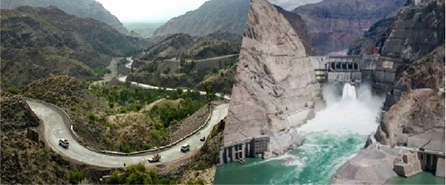
KP’s natural resource base is among the richest in Pakistan and among the least productively utilized. KP’s rivers alone represent some of the most significant untapped energy resources in the country. The province holds an estimated 30,000 megawatts of hydropower potential, nearly half of the national total. Yet only a small fraction has been harnessed. While Pakistan’s overall hydropower exploitation remains limited (about 6,600 MW developed out of roughly 60,000 MW national potential).
KP also possesses significant reserves of natural gas (estimated at 16 trillion cubic feet), marble, limestone and other industrial minerals. Yet rivers flow unused, raw materials leave unprocessed and energy is imported at high cost. Resource abundance, without industrial policy and value addition, has delivered little beyond slogans. The entire local economies depend on mining and quarrying. Still, the dominant model remains extractive: raw materials are exported with minimal processing, while finished products are imported back at higher cost.
The dual impact of this economic loss / crisis is stark: plummeting revenue and vanishing jobs are crippling the economy. Resource abundance, without value addition and regulation, has not delivered prosperity. It has delivered dependence.
Human Capital: Youth as an Unfinished Investment
KP is one of Pakistan’s youngest provinces. More than half its population is under 30, often described as a demographic dividend. But dividends require investment and patience. Literacy rates remain in the mid-50 percent range and education quality varies widely. According to national assessments, literacy in KP is about 51–53 percent, trailing behind provinces like Punjab. On the face of varied education quality, universities produce graduates faster than the economy produces jobs. Technical and vocational training remains underdeveloped and poorly aligned with market needs.
As a result, KP exports labour instead of retaining talent. Migration and remittances keep households afloat but hollow out local productivity. A young population without employment pathways is not an asset but a risk deferred. In other words, KP exports labour, relies on remittances, and struggles to absorb educated graduates into productive work. A demographic dividend, when ignored, turns into a social liability. Human capital is not just about education. It is about absorption. KP educates, but struggles to employ.
Digital Economy: A Narrow Window of Opportunity
Among KP’s many narratives, the digital economy stands out as a rare source of cautious optimism – a rare opening.
In 2025, significant public funds, around Rs18 billion, have been allocated for digital skills development, IT training and technology promotion. Projects such as Haripur Digital City aim to create thousands of tech jobs and integrate KP into global IT markets. Haripur Digital City, costing around Rs8 billion, aimed to create over 4,000 high-tech jobs and generate significant export earnings once operational. Training programmers are designed to reach over 27,000 youth, with scholarships for global certification opportunities. These initiatives matter. Digital services offer KP a chance to bypass some physical and industrial constraints. Freelancing, software services and remote work can connect local talent to global demand; in Pakistan overall, digital platform employment now accounts for a measurable share of the workforce (about 2.9 percent), highlighting the expanding gig and digital labour market.
But digital optimism must be grounded. Training without jobs, freelancing without safeguards and innovation without infrastructure risk becoming yet another half-fulfilled promise. Digital growth demands speed, consistency and infrastructure, which KP’s bureaucracy fails to fairly execute.
The digital window is real but it will not remain open indefinitely.
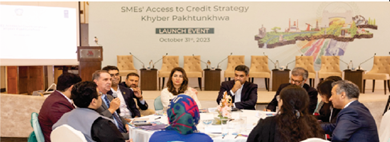
SMEs: The Economy That Carries the Province: Beyond strategies and speeches lies KP’s real economy: small and medium enterprises.
From workshops in Peshawar to agribusinesses in Swat and transport operators across the province, SMEs employ the majority of the workforce. They absorb shocks, create livelihoods and sustain local markets. At the base of the economy sit SMEs, the real employers and the real risk-takers, operating with limited credit, unreliable energy and policy uncertainty. They carry the economy quietly while policy debates orbit elsewhere.
Yet SMEs operate under constant strain, limited access to credit, unreliable energy, regulatory uncertainty and weak legal protection. Facilitation portals and policy announcements help at the margins, but structural constraints remain.
If KP seeks inclusive growth, SMEs must move from the periphery of policy to its centre. Without them, growth will remain narrow and unstable.
Point to Ponder: The End of Comfortable Narratives
By 2025, Khyber Pakhtunkhwa can no longer afford to live off the language of potential. The province does not need another vision document. It needs hard decisions value addition, employment, industrial depth and governance reform.
Natural resources without value addition, youth without employment, fiscal discipline without development and digital ambition without execution all point to the same reality: the province is managing expectations, not transforming its economy.
Potential is not a plan. And 2025 should be the year KP stops living off it.