Hassan Sajid
Across the world, every community has its own way for the resolution of conflicts. Among Pashtuns, one tradition has stood firm for centuries, “the Jirga”. For generations, the Jirga has been the heart of Pashtun society, a respected forum where elders and community members come together to solve disputes with justice, utilizing collective wisdom. Whether the issue be a family conflict, an inter-tribal clash or a major issue of regional peace, the Jirga provides a path that people trust. From resolving enmities and revenge killings to deciding issues of land disputes, water and tribal harmony, the Jirga provides a solution that help prevent violence.
Even today, in a modern and fast-changing era, the people of Khyber Pakhtunkhwa (KP) continue to give great value to this traditional system. The reason is simple, the Jirga has helped the Pashtun people maintain peace during difficult times. In many areas of KP and the newly merged districts, security challenges have increased pressure on communities. But alongside government efforts, political dialogue, and security operations, the Jirga remains a powerful tool for unity and peacebuilding.
Jirga is also a powerful way to educate youth and citizens about unity, responsibility and peaceful coexistence. Through open discussions and guidance from respectful community leaders, a jirga teaches younger generations how to address issues with wisdom instead of violence. It strengthens social values, builds understanding between tribes and communities, and reminds people that progress comes from collective decision-making.
For centuries, Pashtuns have relied on the Jirga to settle even the biggest disputes. It is considered a symbol of justice and fairness—a place where voices are heard, decisions are respected and everyone works together for the common good. This is why today, when KP faces rising security challenges, the Jirga system is once again being recognized as a crucial tool for restoring peace. It is not just a tradition; it is a social system that brings people together.
In recent months, several significant Jirgas have taken place. Some led by top national leadership, others organized by the KP government, political parties and security forces. All these efforts share one goal: restoring lasting peace in KP by engaging the people directly.
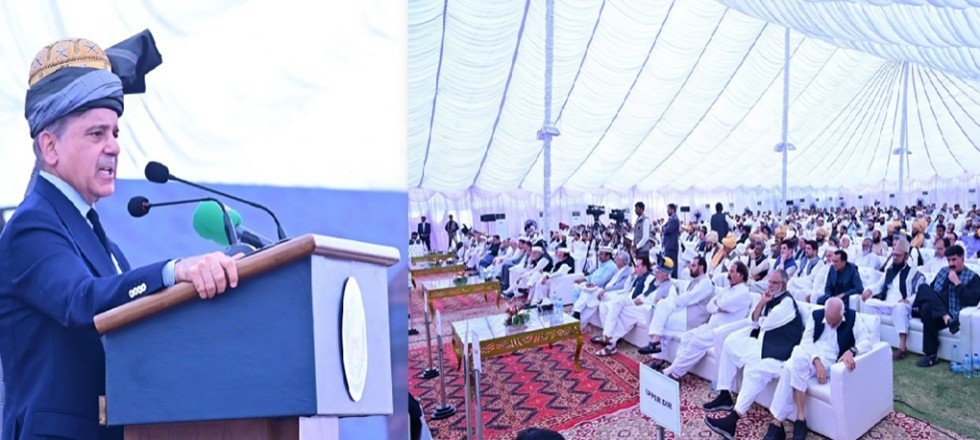
On 3 June 2025, the federal government held a Grand Jirga in Peshawar, underlining its commitment to KP’s peace and stability. In this gathering, Muhammad Shehbaz Sharif, the Prime Minister of Pakistan, addressed tribal elders and people of KP, joined by top military leadership, including Syed Asim Munir, Chief of Army Staff & Defence Forces, along with provincial leadership: the Governor of KP, the then-Chief Minister and other federal and provincial ministers.
This grand Jirga brought together residents, tribal elders, Masharaan (senior tribal figures), Representatives of various political parties, Youth groups, academia and civil society members.
The atmosphere of the Jirga reflected unity and seriousness. People spoke openly about security issues, economic challenges and the growing threat of terrorism in their areas. For many attendees, this was the first time in years that such high-level leadership had come forward to listen directly to the people.
This Jirga agreed upon the following;
The need for a united front against terrorism
- Full cooperation between local communities and security forces
- Strengthening border management
- Improving development in the merged districts
- Addressing the concerns of displaced families
- Ensuring political parties work together for peace
The participation of the Prime Minister and Foreign Minister highlighted that peace in KP is not just a provincial issue, it is a national priority.
Recently, the Inspector General of Frontier Corps (IGFC) KP held a Youth Jirga, bringing together young people from different districts. Youth shared concerns about unemployment, lack of sports facilities and insecurity. They also asked for more educational opportunities and digital training centers.
The purpose was simple: the youth must become partners in peace. Their fresh ideas and energy make them the strongest force against extremism.
The success of the recent peace efforts shows that the Jirga still holds great power. It works because:
- People trust it
- Everyone can speak openly
- It reflects Pashtun values
- Decisions are made collectively
- It prevents violence
- It binds the community together
On 17 August 2025, ANP convened an APC, inviting 19 political parties to discuss the worsening law-and-order situation, grievances of merged districts, alleged resource exploitation and security.
The parties agreed that:
- Terrorism is a threat to everyone, not just one party.
- Political unity is essential for long-term peace in KP.
- The government must take firm action but also ensure human rights.
- Local communities should always be consulted.
- Development and education are key to fighting extremism.
The APC was widely appreciated by the public as a sincere effort, not a political show. For once, parties put aside their rivalries and stood together for the sake of the province.
On 12 November 2025, the second grand effort came when the provincial authorities of KP decided to convene a broad-based Peace Jirga in the KP Provincial Assembly.
This jirga was aimed at forging a unified strategy for restoring peace. It was to bring together sitting and former lawmakers, representatives of all political parties, tribal elders, civil society, lawyers, journalists, former governors and chief ministers, representing “all stakeholders.”
This Jirga was mainly joined by Sohail Afridi Chief Minister of KP, Babar Saleem Swati Speaker of KP Assembly and leaders of political parties (from ruling and opposition), tribal elders, members of civil society, media, lawyers’ bodies, religious scholars and youth.
The Peace Jirga adopted a 15-point declaration. Following are the main demands and recommendations from the declaration of this jirga;
Empower the provincial police and the Counter‑Terrorism Department (CTD) to lead internal security, with constitutional support.
- Provide special financial resources to the police and CTD, given the deteriorating security situation.
- Establish provincial “peace forums” involving civil society, youth, minorities and women, extending beyond politicians or elders alone.
- Demand that the federal government consult KP when shaping policies related to Afghanistan — because foreign & Afghan border policy directly affects KP’s security.
- Reopen and safeguard cross-border trade routes with Afghanistan; resume normal trade; ensure economic development.
- Ensure that local governments in merged districts get full financial rights (linking Provincial Finance Commission with National Finance Commission), giving them autonomy and resources for development.
This jirga stands out as perhaps the broadest inclusive forum in KP’s recent history, where provincial government, parties, civil society, tribal leadership and youth were all present at the same table.
Perhaps the most impactful work is happening at the grassroots level, where local Jirgas are being held by security forces across KP and the newly merged districts. In tribal areas of KP, specifically Khyber, Bajaur, Mohmand, South and North Waziristan, Tank, D.I. Khan, and Lakki Marwat, militants often exploit the geography, tribal rivalries and lack of development. To counter this, the security forces regularly meet with tribal elders in Jirgas to build trust and strengthen cooperation. During these Jirgas, local people are told that peace is only possible when communities stand with the state. Without local support, no operation can completely eliminate terrorism.
Security forces emphasize on identifying and reporting suspicious individuals, exposing facilitators of terrorists, supporting local peace committees, keeping an eye on outsiders entering their villages, protecting schools, health centres, and public property and teaching youth to avoid extremist influence.
In a time when KP faces serious challenges, the Jirga continues to serve as a trusted, respected, and unifying force. As long as communities and leaders continue to use this system wisely, KP can move toward a safer, more peaceful future.