Laila Sadaf
In mid-August 2025, Khyber Pakhtunkhwa (KP) faced one of its darkest hours. Torrential rains, cloudbursts in mountain valleys, flash floods, and landslides struck Buner, Swat, Shangla, Mansehra, Bajaur, Battagram, and Lower Dir in rapid succession. Homes collapsed, roads vanished under water, and bridges crumbled, leaving entire communities cut off. Scores of people died; many more were missing or displaced. Yet amid this devastation, a story of courage and unity emerged—soldiers and citizens working side by side to confront a disaster that seemed overwhelming.
The scale of destruction was staggering. In Buner alone, more than 200 people lost their lives. In Mansehra, Swat, Shangla, and Bajaur, thousands of families were affected as landslides and raging torrents swept through villages. Remote valleys were left inaccessible, worsening the suffering of those stranded.
Amid this chaos, the Pakistan Army stepped in. Acting on directives from Chief of Army Staff Field Marshal Asim Munir, units across KP mobilised to assist in relief and rehabilitation. The Corps of Engineers took on the critical task of repairing broken infrastructure. Where bridges could not be restored immediately, temporary crossings were built to reconnect cut-off communities. Urban Search and Rescue (USAR) teams and K-9 units scoured debris for survivors, while Army aviation helicopters ferried stranded families to safety and delivered food, medicine, and essentials to areas unreachable by road. Medical units set up field camps, treating injuries and addressing outbreaks of waterborne diseases.
In areas like Mansehra and Bajaur, the disaster struck with ferocity. Swollen torrents swept away homes, farmland, and communication lines. Rescue efforts were carried out jointly by soldiers and locals who braved the floods to recover survivors and restore basic links. In villages perched along riverbanks, entire settlements were washed away. Yet local communities did not wait passively. Villagers dug through collapsed roofs, improvised rafts to evacuate families, shared food and blankets, and carried the injured to safer ground. Their knowledge of terrain proved invaluable in guiding Army teams through inaccessible zones.
Restoring connectivity became a lifeline. Army engineers erected temporary bridges, while villagers provided labour and materials to clear debris and lay footpaths. These improvised solutions meant the difference between isolation and survival—enabling medical care, food delivery, and evacuation of children and the elderly.
The coordination between military and civilian disaster units further amplified relief. USAR teams, aviation squads, and engineers worked alongside the Provincial Disaster Management Authority (PDMA), Rescue 1122, local volunteers, and NGOs. The PDMA declared emergencies, collected casualty data, and managed relief camps, while the NDMA coordinated federal support. Despite poor weather and treacherous terrain, more than 6,900 people were rescued, over 6,300 treated at medical camps, and nearly 600 tonnes of rations distributed. Roads were cleared in fragments, allowing convoys to reach deeper into affected areas.
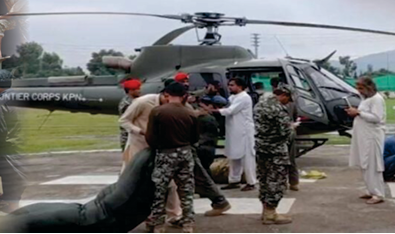 The work was not without risks. In some valleys, heavy rains and landslides prevented even helicopters from reaching those in need. Rescue operations at night were dangerous, and some soldiers and relief workers lost their lives in service. Yet despite these challenges, the joint effort of disciplined troops and courageous citizens saved thousands from certain tragedy.
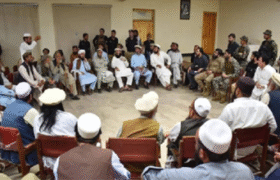
In Mansehra, survivors recalled how neighbours opened their homes to the displaced and shared meagre supplies of food. In Bajaur, locals used bamboo planks and rafts to cross rivers until temporary bridges arrived. These acts of solidarity were as vital as official rescues.
The recovery phase has now shifted focus toward rebuilding with resilience. Army and civil engineers are working together to redesign bridges, strengthen embankments, and improve early warning systems. Local governments are distributing compensation, rebuilding homes, and planning permanent road and bridge reconstruction. The Army’s decision to donate one day’s salary from all personnel, along with over 600 tonnes of rations, symbolised a message of national unity—that every Pakistani has a role in overcoming the crisis.
The floods have left scars across KP, with livelihoods destroyed and infrastructure in ruins. But they also rekindled a spirit of solidarity, proving that soldiers and citizens together are stronger than disaster. As rebuilding begins, the province’s future resilience will depend on preserving this unity, strengthening local capacities, and investing in infrastructure that can withstand the next storm. When calamity returns, as it inevitably will, the people of Khyber Pakhtunkhwa will be more prepared—and more united.