Zeeshan Hoti
One year has passed since Pakistan stood at one of the most critical crossroads in its modern history. Following Pahalgam false flag, India launched Operation Sindoor, in the middle of night between 6 and 7 May 2025, firing missiles at Pakistani cities, killing innocent civilians including women, children and elderly, and damaging Masajid and civilian properties. The attack was unprovoked, sudden and deeply shocking to the Pakistani nation. But what followed in the days after was something that the world had not expected — a calm, precise and devastating military response that changed the strategic balance of South Asia forever. Yes, it was the “Operation Bunyan-Um-Marsoos” that will be remembered for the generations in the war history of humanity.
On May 10, 2025 just after Fajr prayers, Pakistan launched Operation Bunyan-Um-Marsoos — words taken from the Holy Quran, Surah Al-Saff (61:4), meaning “a structure firmly joined together” or “a wall cemented with molten lead.” The name was not chosen arbitrarily. It spoke directly to the soul of the Pakistani people, reminding them that strength comes from unity, and that a nation joined together in faith and purpose cannot be broken. Chief of Army Staff Field Marshal Syed Asim Munir recited Surah Al-Saff before the operation began, setting the spiritual and moral tone for what was to follow. Pakistan targeted key Indian military installations including the Pathankot, Udhampur and Gujarat air bases, a BrahMos missile storage site in Beas and radar installations in Poonch, with surgical precision. The enemy suffered heavy losses. The entire operation was a demonstration not just of military power, but of national will.
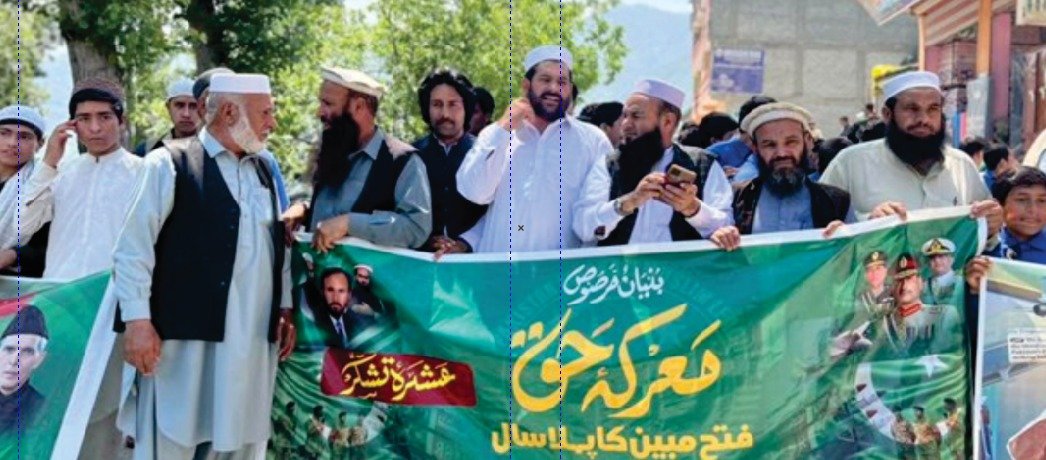
As Pakistan marked the first anniversary of this Marka-e-Haq, as this conflict came to be known, the streets of Khyber Pakhtunkhwa (KP) told a story of a people who had never hesitated in their support for their soldiers. From Peshawar to Chitral, DI Khan to Waziristan, and from Swat to Kohistan, people poured out in solidarity rallies, walks and public gatherings. Traders, auto-rickshaw owners, students, government officials, women’s wings of political parties, academics, and ordinary citizens came together under one flag—the green and white banner of Pakistan. In Peshawar, a large central rally was held outside the historic Balahisar Fort, where participants chanted slogans of “Pakistan Zindabad” and “Pakistan Armed Forces Zindabad”, celebrating the nation’s victory with pride and joy.
What made these scenes in KP especially meaningful was their spontaneity. These were not organized by distant government offices. These were communities — men, women and young people — stepping out of their homes and their shops because they genuinely felt pride in their soldiers and their country. When Indian missiles fell on Pakistani soil, it was the people of KP, with a long memory of what it means to face aggression, who felt the call most deeply. The rallies were their answer — a living expression of the Quranic verse after which the operation itself was named. They stood as one wall, firm and unshakeable.
On the anniversary itself, Pakistan’s civil and military leadership came together at a solemn ceremony at General Headquarters in Rawalpindi to reaffirm the armed forces’ resolve to defend the motherland. Field Marshal Syed Asim Munir, Chief of Defence Forces and Chief of Army Staff, addressed the nation with words that carried both gratitude and warning. He said that the confrontation from the night of May 6 to 7 until May 10 had been an unsuccessful attempt by the enemy to test Pakistan’s national resolve and dignity. He reminded the nation that Pakistan’s armed forces had never bowed to the dominance of power in the past and would never do so in the future. “The entire nation stood like a solid wall in the defence of the homeland,” he said. “When Indian missiles fell, a large number of people came out in support of the country’s defence.” He paid tribute to the unarmed women, the elderly, and the innocent children who were martyred during Marka-e-Haq — lives lost not on a battlefield but in their own homes, in their own cities, because of an enemy that chose to target civilians.
The warning issued by the Field Marshal was equally clear. He told the world that any future aggression against Pakistan would have far-reaching and painful consequences. This was not an idle threat. It was the voice of an institution that had just proven, to itself and to the world, that it was capable of delivering exactly what it promised. Chief of Naval Staff Admiral Naveed Ashraf and Chief of the Air Staff Air Chief Marshal Zaheer Ahmed Baber also attended the ceremony, joining in a joint message that described the anniversary as “being observed with deep reverence, gratitude and national fervour.” The military leadership stated that Marka-e-Haq was a defining milestone in Pakistan’s history that demonstrated national resolve, strategic maturity and military capability. They pledged that the armed forces would remain “shoulder to shoulder” with the people of Pakistan, maintaining an unbreakable bond with the nation they proudly served.
Prime Minister Shehbaz Sharif also addressed the nation, calling Marka-e-Haq an “epic feat of achieving overwhelming dominance over an enemy bent on unprovoked aggression.” He said the well-coordinated and synchronized response of Pakistani forces across land, sea, air and cyber domains had established Pakistan as an invincible nation. He paid glowing tribute to Field Marshal Asim Munir and the military leadership, calling their conduct a shining chapter written in the Pakistan-India context. The National Assembly of Pakistan also passed a unanimous resolution on the same occasion, reaffirming the “unwavering resolve and determination of the nation to stand with the armed forces of Pakistan in defending the geographical and ideological frontiers of the motherland, come what may.”
Perhaps the most lasting consequence of Operation Bunyan Um Marsoos is what it has revealed about Pakistan’s emergence as a serious military power in the modern era. What unfolded on May 10, 2025, was not a conventional military exchange. It was a coordinated, multi-domain military campaign that fused missile systems, drone swarms, electronic warfare and offensive cyber operations into a single, tightly controlled operation. Military analysts around the world have noted that Pakistan demonstrated, in real combat conditions, what many had only theorized about: the power of multi-domain integration.
Pakistan’s Fatah ballistic missiles, used in the operation with high precision, signaled a new level of indigenous weapons capability. The Pakistan Air Force demonstrated precision strike capability that left military observers across the globe taking note. Pakistani drones reportedly flew deep into Indian airspace, reaching distances of 400 kilometers from Lahore. It was a demonstration of the country’s deep-strike capability that was both technically impressive and strategically significant. Pakistan also claimed to have targeted and damaged India’s S-400 long-range surface-to-air missile system — a weapon widely considered one of the most sophisticated air defense systems in the world.
Analysts have described Operation Bunyan-um-Marsoos as a turning point in South Asian military dynamics. Pakistan’s ability to handle high-intensity military aggression from a country three times its size, without crossing the nuclear threshold, reflected both strategic maturity and operational excellence. The Pakistan Air Force achieved notable operational successes that were described as well-documented and beyond dispute. The Pakistan Navy, meanwhile, held its position with such strength that it was in a position to sink an Indian aircraft carrier — yet chose restraint, because the goal was not escalation but deterrence. This combination of capability and discipline is precisely what defines an emerging military power in the modern world.
This operation reshaped Pakistan’s diplomatic standing. The international community, which had watched events unfold in real time, recognized that Pakistan was no longer simply a reactive power but a nation with a clear strategic doctrine. Pakistan’s success in Marka-e-Haq, in the words of Field Marshal Munir, had strengthened the country’s diplomatic standing, with the international community recognizing Pakistan as what he called an “unconquerable force” and an indispensable regional reality. The description was earned, not claimed.
As Pakistan marks the first anniversary of Operation Bunyan-um-Marsoos and Marka-e-Haq, the celebrations across the country carry a deeper meaning than mere commemoration. They are a reaffirmation of who Pakistanis are as a people. They are a reminder that when a nation faces aggression with unity, faith and discipline, it cannot be defeated.