DISINFORMATION, PROXY NETWORKS AND DIGITAL RADICALIZATION
ZEESHAN HOTI
In modern conflict, the battlefield is no longer limited to land, sea or air. Information, perception and digital space have become powerful instruments of strategic competition.
This transformation has given rise to hybrid warfare, a form of conflict that combines traditional security pressure with non-military tools such as disinformation campaigns, cyber operations, psychological manipulation, economic pressure and the use of proxies.
For countries like Pakistan, these threats are not theoretical. They manifest daily through coordinated propaganda, weaponised misinformation and attempts to manipulate public opinion through digital platforms.
Hybrid warfare operates quietly but strategically. Instead of open confrontation, adversaries seek to weaken a nation internally. The goal is to create confusion, erode trust in state institutions, polarize society and shape international perceptions.
By influencing the information environment, hostile actors attempt to achieve political and strategic objectives without firing a single shot.
The concept of hybrid warfare reflects the changing nature of global conflict. In earlier decades, military strength was measured by the size of armies and
weapons systems. Today, influence over information flows is equally powerful.
Strategic narratives, online propaganda and psychological operations can shape how societies think and respond to crises. Pakistan’s geopolitical position and regional dynamics make it particularly vulnerable to such tactics.
Disinformation campaigns often attempt to exploit existing social, political or economic debates within the country. By amplifying divisions and spreading confusion, hybrid warfare aims to weaken national cohesion and decision-making processes.
These operations typically involve several interconnected tools: media manipulation, covert support to proxy networks and digital radicalization. Each component reinforces the others, creating a complex web of influence that is difficult to detect and counter.
One of the most important arenas of hybrid warfare today is social media. Platforms that were originally designed for communication and community building have become powerful channels for information manipulation. Coordinated networks of fake accounts, automated bots and anonymous pages are often used to amplify propaganda narratives targeting Pakistan. False stories, manipulated images and misleading videos can reach millions of users within minutes.
Because social media content often appeals to emotion rather than verification, many users unknowingly share misinformation, further amplifying its reach.
Disinformation campaigns frequently target sensitive topics such as political stability, economic challenges, civil-military relations and ethnic or regional identities. By exaggerating problems or presenting distorted narratives, hostile actors attempt to create the perception that Pakistan is unstable or internally divided.
Another dimension of hybrid warfare involves the use of proxy actors. Rather than confrontation, hostile states or networks may rely on militant groups, criminal organizations, and/ or covert operatives to conduct disruptive activities.
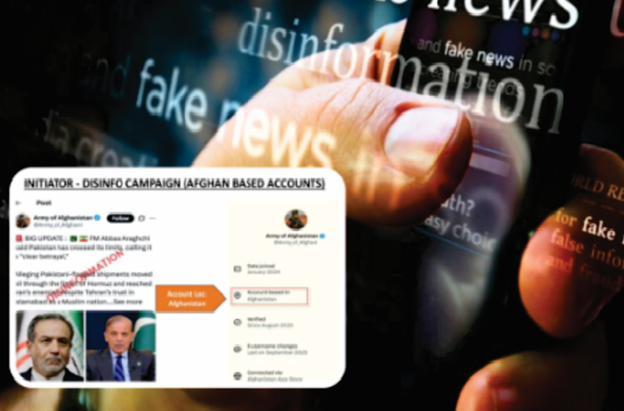
These proxy networks allow adversaries to maintain plausible deniability while still exerting strategic pressure. Security analysts often point to the complex regional dynamics involving Afghanistan and India when discussing such networks.
Proxy actors also play a role in information warfare. Local voices or anonymous accounts may spread narratives that appear authentic but are actually part of a coordinated disinformation strategy. This method increases the credibility of propaganda while hiding its true origins.
Hybrid warfare is closely linked with what many analysts call fifth generation warfare (5GW). In this form of conflict, the primary battlefield is the human mind. Perception, psychology and narrative control become decisive tools.
A clear example of this phenomenon is the spread of fabricated or exaggerated claims about military events. During periods of regional tension, hostile media outlets and coordinated social media networks often circulate false reports designed to create panic or undermine confidence in Pakistan’s defense capabilities.
One widely discussed example involved propaganda claiming that Noor Khan Air Base had been destroyed during a Pakistan-Afghanistan conflict andthat Afghan forces had shot down Pakistani fighter jets. These claims circulated widely on social media and in certain hostile media circles. However, the narrative collapsed under basic scrutiny.
In reality, Afghanistan does not possess the advanced military technology or operational capability required to carry out such an attack. The country lacks a sophisticated air defense system capable of targeting modern Pakistani fighter aircraft.
Without radar-guided air defense infrastructure or advanced missile systems, destroying a major air base or intercepting fighter jet would be practically impossible.
The misinformation becomes even clearer when compared with regional realities. During the recent Pakistan-India military tensions, India—despite having modern and sophisticated air defense systems—was unable to destroy Pakistani fighter jets.
If a technologically advanced military could not achieve such results, the claim that Afghanistan could do so without a comparable defense system demonstrates how unrealistic and manipulative such propaganda narratives are.
This example illustrates the essence of fifth generation warfare. The objective is not necessarily to convince military experts but to influence public perception. Once misinformation spreads widely enough, it creates doubt, confusion and unnecessary fear among the public.
Another serious aspect of hybrid warfare is digital radicalization. Online platforms allow extremist groups and hostile networks to distribute ideological material, recruit individuals and create echo chambers that reinforce radical beliefs. Young people are particularly vulnerable in this environment. Exposure to repeated propaganda, conspiracy theories and emotionally charged narratives can gradually influence attitudes. Over time, individuals may become more susceptible to extremist ideologies or hostile narratives that portray the state and its institutions negatively.
The power of disinformation lies in its psychological effect. Continuous exposure to negative narratives can gradually weaken public confidence in national institutions. If citizens begin to doubt their government, security forces or media organizations, the overall stability of the state can be affected.
Disinformation campaigns become especially dangerous during crises. In times of political tension, security incidents and natural disasters, false information spreads rapidly and complicates decision-making. Rumors can trigger panic, deepen divisions and disrupt effective governance.
For Pakistan, which already faces complex regional and security challenges, the psychological dimension of hybrid warfare requires serious attention. Winning the information battle is increasingly as important as maintaining traditional defense capabilities.
To counter hybrid warfare, Pakistan must develop a comprehensive national response centered on strategic communication and public awareness. A strong national counter-narrative is essential to challenge false propaganda and promote factual information.
Government institutions, media organizations, academic experts and civil society must work together to create credible communication channels. Transparent and timely information from official sources can reduce the space for rumors and misinformation. Media literacy is another critical component of national resilience. Pakistan also needs stronger technological capabilities to detect and counter coordinated disinformation campaigns.
Cooperation with global technology platforms is equally important. Social media companies must play a responsible role in identifying and removing coordinated misinformation networks targeting national stability.
At the same time, any regulatory measures should maintain a balance between national security and freedom of expression. Effective counter-hybrid strategies require transparency, accountability and respect for democratic values.
Ultimately, the most effective defense against hybrid warfare is an informed and united society. When citizens understand how misinformation works and remain confident in their institutions, the impact of hostile narratives is significantly reduced. In the evolving battlespace of the digital age, safeguarding truth and national cohesion has become as critical as defending physical borders.