BY: LAILA SADAF
Khyber Pakhtunkhwa (KP), long perceived as the frontline of Pakistan’s fight against terrorism, is steadily scripting a narrative of resilience, reform and strategic recalibration. While the province continues to grapple with the resurgence of terrorism, a closer examination reveals a tapestry of tangible gains rooted in technological advancement, institutional strengthening and coordinated counter-terrorism efforts.
At the heart of this transformation lies the Peshawar Safe City Project, a landmark initiative that signifies a decisive shift from conventional policing to a technologically driven security paradigm. The project integrates surveillance systems, emergency response mechanisms and traffic management into a unified command-and-control infrastructure, heralding what officials describe as an “ironclad digital era” for law enforcement.
Such initiatives are not merely infrastructural embellishments; they represent a strategic pivot towards intelligence-led policing, where data, connectivity and real-time monitoring become the new sentinels of public safety.
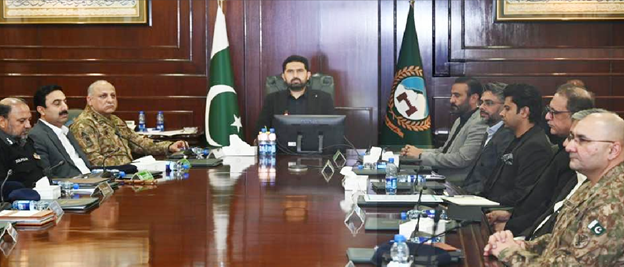
Beyond urban surveillance, the provincial government has undertaken efforts to expand these security frameworks across multiple districts, particularly those historically afflicted by militancy. The planned extension of safe city systems to southern districts such as Dera Ismail Khan, Bannu and North Waziristan reflects a broader vision of geographically inclusive security reform.
This expansion underscores a recognition that security cannot remain confined to urban enclaves but must permeate the province’s most vulnerable frontiers.
Equally significant are the operational gains achieved through enhanced counter-terrorism coordination. Law enforcement agencies, including the police, Counter-Terrorism Department and Special Branch, have demonstrated increasing operational synergy. Their sustained efforts have thwarted numerous potential attacks, reinforcing the state’s defensive posture against evolving militantstrategies.
Recent joint operations, resulting in the elimination of militants, further highlight a proactive rather than reactive approach to security management.
However, these gains unfold against a complex and often volatile backdrop. The resurgence of militant activity, particularly by Fitna-Al-Khawarij (FAK), has intensified the security challenge. Incidents across various districts in 2026, including targeted attacks on security personnel and civilians, serve as stark reminders of the persistent threat landscape.
Yet, paradoxically, it is within this crucible of adversity that the province’s institutional resilience is being forged.
A crucial dimension of KP’s progress lies in its evolving policy discourse on counterterrorism. Provincial leadership has increasingly emphasized the necessity of inclusive policy making, advocating for consultation with local stakeholders, political parties and the federal government. This call for cooperative governance reflects an understanding that sustainable peace cannot be engineered through unilateral decisions but requires collective ownership and consensus-building.
The emphasis on dialogue, alongside security operations, signals a nuanced approach that blends hard power with political engagement.
Moreover, the modernization of law enforcement agencies stands as a cornerstone of these gains. Investments in advanced technology, improved training and enhanced operational capabilities are gradually transforming the police force into a more agile and responsive institution. As officials acknowledge, the complexities of modern terrorism demand not only courage but also innovation and adaptability.
In essence, KP’s journey is not one of unbroken triumph but of measured progress amid persistent trials. The province continues to walk a tightrope between challenge and change, where every gain is hard-earned and often contested. Yet, the trajectory remains unmistakably forward-looking.
An equally consequential yet often understated gain lies in the gradual dismantling of extremist propaganda and the containment of radicalization, achieved through a calibrated blend of civil-military cooperation, inclusivity and public engagement.
Recognizing that militancy thrives not merely on weapons but on narratives, state institutions have increasingly focused on countering ideological indoctrination at its roots. Collaborative efforts between security forces, civil administration, educational institutions and community leaders have fostered a more resilient social fabric, one that is less susceptible to divisive rhetoric. Public awareness campaigns, youth engagement initiatives of Pak Army in educational institutions and the promotion of inclusive governance have begun to reclaim the intellectual and cultural space once exploited by extremist elements.